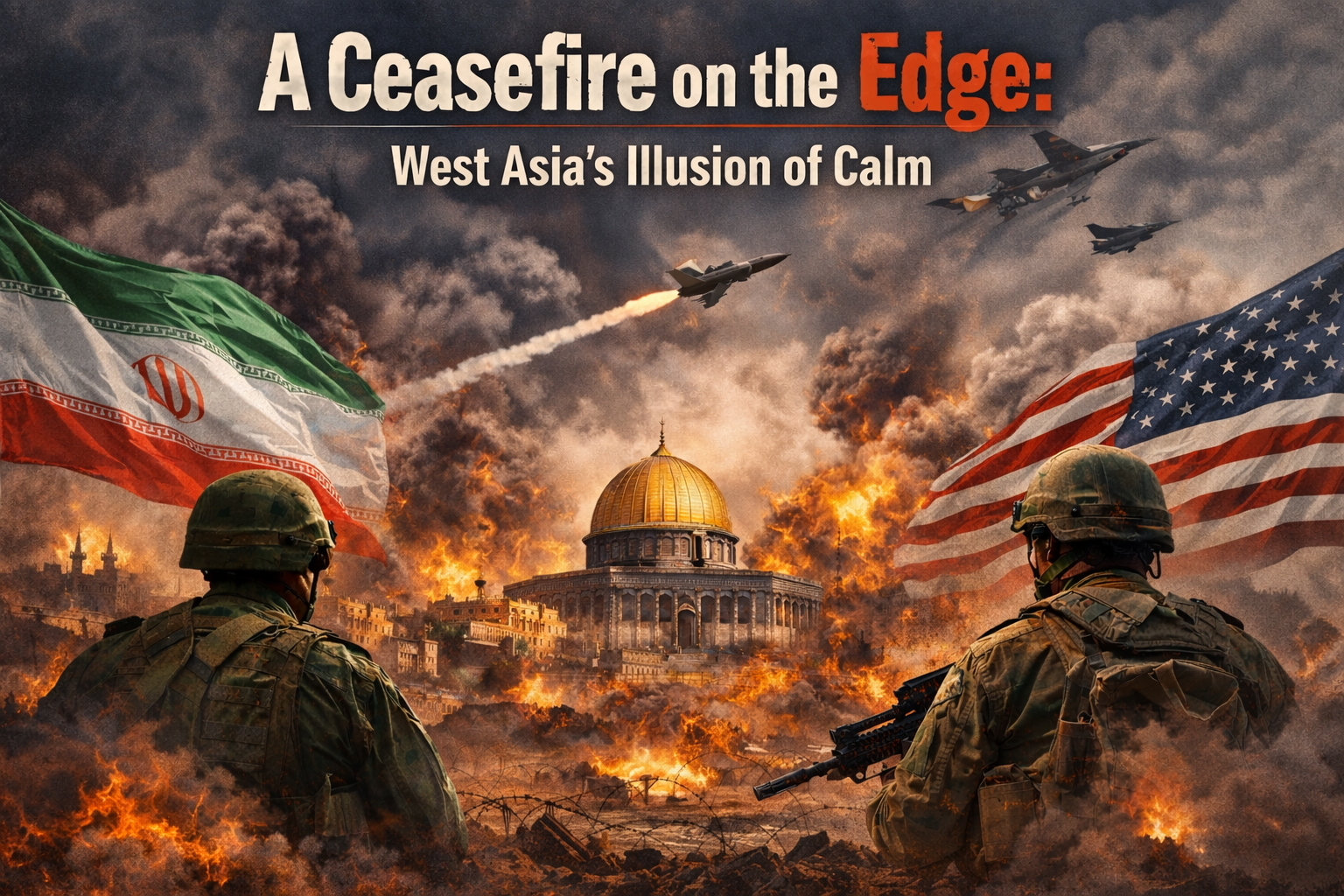
A fragile truce between Iran, Israel, and the United States offers the world a pause—but not peace—as deeper fault lines remain unresolved.
The guns may have fallen silent—for now—but the silence across West Asia is deceptive. The ongoing ceasefire involving Iran, Israel, and the United States is not a product of reconciliation. It is a temporary alignment of compulsions, shaped by global pressure, economic risk, and the looming fear of a wider war.
At its core, this is not peace. It is a calculated pause.
*The Anatomy of a Fragile Truce*
The present ceasefire rests on unstable ground. None of the fundamental disputes have been resolved. Iran’s nuclear ambitions remain a central concern for Israel and the United States. Economic sanctions continue to suffocate Tehran, while Israel’s security establishment remains deeply wary of any long-term strategic compromise.
Such contradictions are not easily reconciled. They are merely postponed.
The region’s history offers a sobering lesson: ceasefires without political settlements rarely endure. They linger, fracture, and eventually collapse under the weight of unresolved tensions.
*The Triggers Beneath the Surface*
Several flashpoints threaten to undo the current calm.
Foremost among them is the question of nuclear escalation. Any indication that Iran is advancing its nuclear programme beyond acceptable thresholds could provoke a pre-emptive Israeli strike. Such a move would almost certainly draw the United States into direct confrontation.
Equally volatile is the network of proxy forces aligned with Iran, including Hezbollah. Operating beyond Iran’s borders, these groups possess the capacity to ignite conflict without direct state involvement, creating plausible deniability while escalating tensions.
Then there is the strategic vulnerability of the Strait of Hormuz—a narrow maritime corridor through which a significant portion of the world’s oil supply flows. Any disruption here would not merely be a regional crisis; it would be a global economic shock.
Finally, the risk of miscalculation looms large. In an environment saturated with military assets, drones, and rapid-response systems, even a minor error can spiral into a full-scale confrontation.
*Pakistan’s Quiet Diplomacy*
Amid this uncertainty, Pakistan has emerged as an unlikely but important intermediary. Leveraging its geographic proximity to Iran and its strategic ties with the United States, Pakistan has positioned itself as a conduit for dialogue.
Its role, however, must be understood with clarity. Pakistan is not a power capable of dictating outcomes. It is a facilitator—bridging communication gaps, reducing immediate tensions, and enabling backchannel negotiations.
Its influence lies in access, not authority.
*Why India Must Watch Closely*
For India, the stakes are immediate and tangible. A breakdown of the ceasefire would send shockwaves far beyond West Asia.
India’s dependence on energy imports makes it particularly vulnerable to disruptions in the Strait of Hormuz. Any spike in oil prices would directly impact inflation, economic stability, and household budgets.
Additionally, millions of Indian citizens live and work across the Gulf region. A renewed conflict would place them at risk, potentially necessitating large-scale evacuation efforts under difficult circumstances.
India also finds itself walking a delicate diplomatic line—maintaining relationships with Iran, Israel, and the United States simultaneously. A prolonged conflict would test this balance, forcing complex strategic choices.
*A Pause, Not a Resolution*
The current ceasefire offers breathing space—but little else. It has slowed the momentum of conflict without addressing its causes. The deeper issues—nuclear ambitions, regional rivalries, and security anxieties—remain firmly in place.
Peace, in its true sense, requires more than silence. It demands compromise, trust, and structural change—none of which are yet visible on the horizon.
*Conclusion*
The world would do well not to mistake stillness for stability. The ceasefire in West Asia is a momentary equilibrium, not a lasting solution. It is a reminder that in geopolitics, the absence of war does not always signify the presence of peace.
For now, the region stands suspended between escalation and diplomacy—its future uncertain, its tensions unresolved, and its calm profoundly fragile.