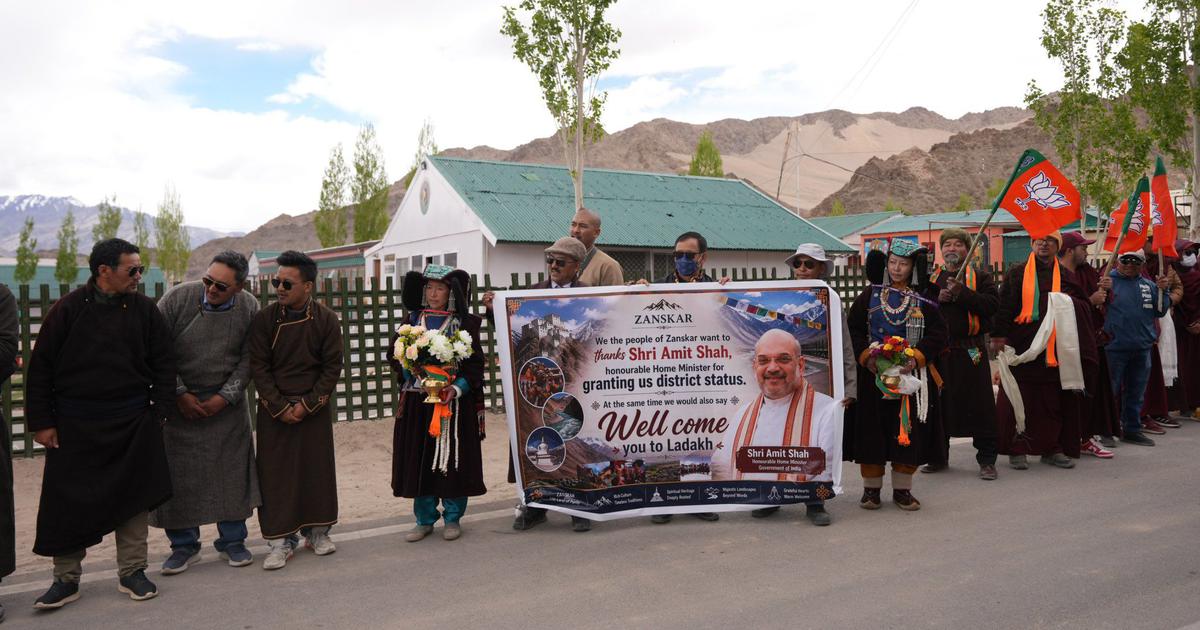
In a significant administrative move, the Indian government announced the establishment of five new districts in the Union Territory of Ladakh last month. This decision, which was approved earlier in 2024, was formalized on April 27, just days before Union Home Minister Amit Shah’s visit to the region. However, this development has sparked concerns among the local Muslim-majority community, who are wary that the reconfiguration of district boundaries may lead to their marginalization.
Ladakh, known for its breathtaking landscapes and sparse population, now has a total of seven districts following this latest change. The region, with a population of approximately 274,000 as per the 2011 census, is home to a diverse demographic. Muslims constitute around 46% of the population, while Buddhists account for about 39%, and Hindus make up just over 12%. The demographic makeup is unevenly distributed, with most Muslims residing in Kargil district, and Buddhists primarily concentrated in Leh.
Sajjad Kargili, an influential activist from Kargil, voiced the apprehensions of many local residents, stating, “The demographic distribution of Ladakh does not reflect in the creation of the new districts.” His remarks underscore a prevalent fear that the new administrative boundaries could dilute the representation of the Muslim population, who predominantly reside in the two districts of Kargil and Leh. Activists and citizens alike express concern that five out of the seven newly formed districts may be dominated by the Buddhist community, leading to an imbalance in political representation.
The apprehensions regarding potential gerrymandering and exclusion are not unfounded; the historical context of Ladakh’s political landscape has seen varying degrees of representation for its diverse communities. Since the region’s elevation to a Union Territory in 2019, there have been ongoing discussions about autonomy and the preservation of cultural identities. The new district configuration could further complicate these issues, particularly for the Muslim population, which feels it may be sidelined in future political deliberations.
This decision comes amidst a broader conversation about governance and representation in India’s Union Territories. Leaders from various communities have called for a more inclusive approach, urging the government to consider the unique demographics of Ladakh while planning administrative divisions. As the region grapples with these changes, it remains crucial for local voices to be heard and for the government to address the concerns of all communities to foster harmony in this strategically significant area.