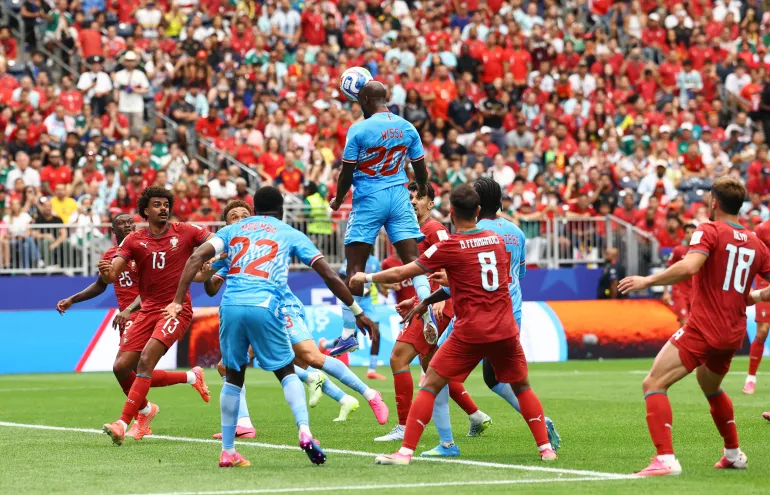
After 52 years away from football’s biggest stage, DR Congo returned to the FIFA World Cup with a disciplined performance against Portugal, highlighting the team’s progress under head coach Sébastien Desabre.
For more than half a century, the Democratic Republic of Congo waited for another opportunity to compete at the FIFA World Cup.
The nation’s previous appearance came in 1974 when it participated as Zaire. That tournament remains a significant chapter in the country’s football history, as the team was unable to advance beyond the group stage.
Fifty-two years later, the Leopards returned to the global stage.
In their opening match of the 2026 FIFA World Cup, DR Congo faced Portugal and earned a 1-1 draw, delivering a performance built on tactical organization, defensive discipline, and teamwork.
A key figure in the team’s revival has been head coach Sébastien Desabre.
Since taking charge in 2022, Desabre has worked to build a cohesive unit from a squad containing players with experience across several European leagues. His approach has emphasized defensive structure, compact organization, and quick transitions.
Those principles were evident throughout the match against Portugal.
Recognizing Portugal’s strength in possession, DR Congo adopted a compact defensive shape, often operating with five defenders when out of possession. The midfield remained organized and disciplined, limiting space in central areas and forcing attacks into wider positions.
Portugal controlled much of the possession, but DR Congo remained patient and organized throughout the contest.
Even after Portugal opened the scoring through João Neves in the sixth minute, the Congolese side maintained its tactical discipline and continued to execute its game plan.
Leading the team was captain Chancel Mbemba.
Born in Kinshasa, Mbemba has built a professional career that has included spells with clubs such as Newcastle United, FC Porto, and Olympique de Marseille. He remains one of the most experienced and respected members of the national team setup.
The squad also includes players such as Axel Tuanzebe and Aaron Wan-Bissaka, who represented England at youth level before committing to DR Congo at senior international level.
DR Congo equalized deep into first-half stoppage time when Arthur Masuaku delivered a corner that was headed into the net by Yoane Wissa.
The goal marked an important moment for DR Congo in its return to the World Cup stage.
Wissa’s career has included significant challenges. In 2021, he suffered serious injuries during an acid attack linked to a burglary attempt at his home in England. After recovering and returning to professional football, he continued to establish himself at club and international level.
Veteran striker Cédric Bakambu also remains an important member of the squad. Born in France, Bakambu represented French youth teams before choosing to play internationally for DR Congo.
The team’s World Cup qualification and participation have been viewed by many supporters as an important achievement for Congolese football. Players and coaching staff have frequently spoken about representing supporters across the country and inspiring future generations of footballers.
Against Portugal, DR Congo combined defensive organization with attacking intent. While much attention focused on the team’s resilience without possession, the Leopards also created opportunities through counterattacks and set-piece situations.
When the final whistle sounded, the players celebrated the result and their return to football’s biggest tournament after more than five decades away.
Regardless of what follows in the competition, the performance against Portugal demonstrated the progress made by DR Congo under Sébastien Desabre and highlighted the team’s ability to compete against established international opponents.
For supporters, the match represented another chapter in the ongoing development of Congolese football and a memorable moment in the nation’s World Cup journey.