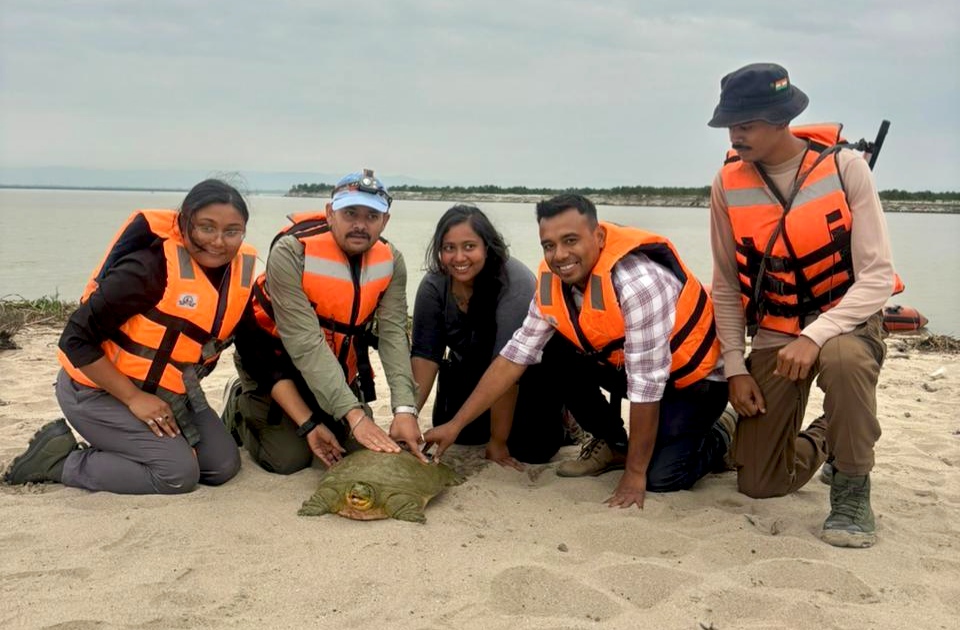
Specialists at the Kaziranga National Park and Tiger Reserve have successfully received satellite signals from a Ganges softshell turtle fitted with a high-tech tracking device, marking a significant development in turtle conservation research in India.
The turtle was captured at the confluence of the Brahmaputra and Borgang rivers in the Kathnibari area of Kaziranga’s Sixth Addition by scientists and researchers from the Wildlife Institute of India with support from Kaziranga National Park authorities.
On April 28, researchers fitted the turtle with a satellite-linked tracking device before releasing it back into the same location. The technology will allow scientists to monitor the turtle’s movement, habitat use and migration patterns in greater detail.
According to officials associated with the project, this is the first satellite-linked monitoring initiative for a Ganges softshell turtle in India. The project is being led by Dr. Abhijit Das of the Wildlife Institute of India.
The successful reception of satellite signals coincided with World Endangered Species Day. Assam Chief Minister Himanta Biswa Sarma described the development as “a proud moment for Assam” and reiterated the state’s commitment to wildlife conservation.
The Brahmaputra Valley is considered an important region for riverine turtle conservation. Assam is home to 21 turtle species, making it one of Asia’s key biodiversity regions. Of the eight softshell turtle species found in India, five are reported from Kaziranga, underlining the park’s ecological significance.
Dr. Abhijit Das said that identifying seasonal migration routes, habitat ranges and breeding grounds is important for the long-term conservation and management of softshell turtles in the Brahmaputra Valley.
The project is being implemented by the Wildlife Institute of India with support from the Ministry of Environment, Forest and Climate Change, in collaboration with the Assam Forest Department and Kaziranga authorities. Financial support for the initiative has been provided by the National Geographic Society.
Researchers will continue monitoring the turtle’s movements through satellite tracking in the coming months.