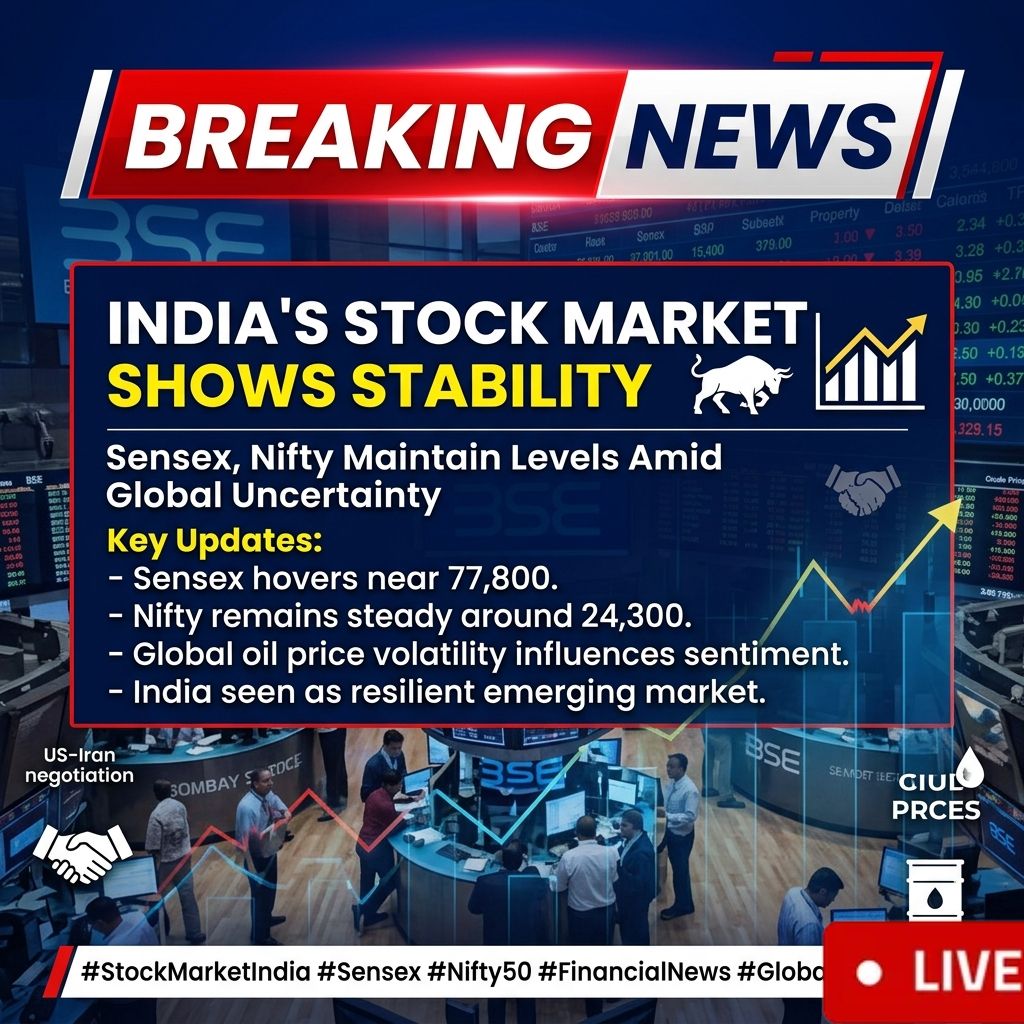
India’s stock markets continued to show relative stability despite ongoing global economic uncertainty and broader geopolitical developments. Investors remained cautious, while overall market sentiment stayed balanced, reflecting the resilience of the Indian financial system.
Market Performance Overview
Indian benchmark indices traded within a narrow range during the session:
- Sensex hovered around the 77,800 level
- Nifty 50 remained near the 24,300 level
Despite minor fluctuations, there was no sharp volatility, indicating that markets are cautiously responding to global developments rather than reacting aggressively.
Global Factors Influencing the Market
Crude Oil Price Volatility
Global crude oil prices remained somewhat unstable due to changing demand expectations and supply-related concerns. Since India is one of the world’s major oil importers, fluctuations in crude prices can influence:
- Inflation expectations
- Transportation and logistics costs
- Corporate profitability across sectors
Broader Geopolitical Developments
Global geopolitical developments and international economic uncertainty continue to keep investors attentive to potential market risks. Such developments may influence:
- Global energy markets
- Foreign investment flows
- Currency stability in emerging economies
As a result, investors are maintaining a cautious approach toward short-term market movements.
Investor Sentiment Remains Balanced
Market participants largely adopted a “wait-and-watch” strategy:
- Institutional investors avoided aggressive positioning
- Retail investors remained selective in stock purchases
- Defensive sectors such as FMCG, IT, and pharmaceuticals continued to attract steady interest
Overall, the market did not witness panic selling or major speculative rallies.
Domestic Support Factors
Despite external uncertainty, several domestic factors continue to support Indian markets:
- Strong mutual fund inflows
- Stable corporate earnings expectations
- Ongoing economic growth momentum
- RBI’s cautious monetary policy approach
These factors have helped maintain relative market stability.
Market Outlook
Analysts suggest that:
- Short-term volatility may continue due to global developments
- Crude oil prices will remain an important factor for market sentiment
- Domestic consumption trends and corporate earnings may guide medium-term direction
Many analysts continue to view India as a relatively stable emerging market supported by strong domestic fundamentals.
Conclusion
The Indian stock market’s ability to remain stable near the Sensex 77,800 and Nifty 24,300 levels highlights resilience amid global uncertainty. While international developments continue to influence investor sentiment, domestic economic strength and steady institutional participation continue to provide support to the broader market.