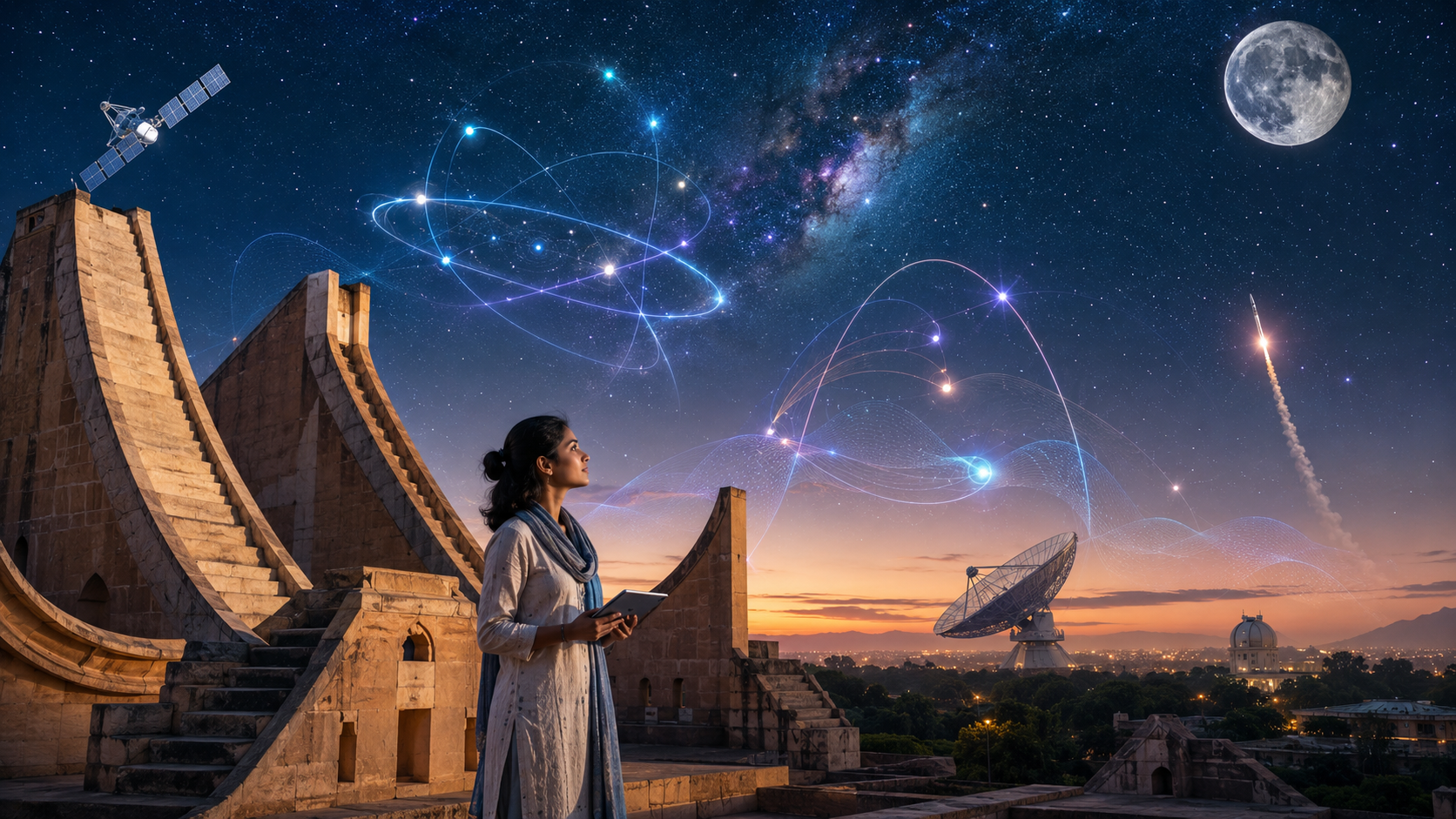
From Jantar Mantar to Chandrayaan, from philosophical inquiry to quantum communication, India’s scientific future is increasingly being shaped by a long tradition of curiosity about the universe and the natural world.
There is a quiet sense of wonder at Jantar Mantar in Jaipur. The instruments are made of stone, lime and geometry rather than silicon or steel. They do not compute or transmit data in the modern sense, yet they were designed to measure the sky with remarkable precision.
Standing before these astronomical structures highlights that India’s engagement with the universe did not begin with rockets or satellites. It began with observation, mathematics, timekeeping and attempts to understand celestial movement through systematic study.
Today, that scientific curiosity has entered a new technological era. India is studying the cosmos through satellites, radio telescopes, solar observatories, gravitational-wave detectors and quantum technologies. While the technologies have evolved significantly, interest in astronomy and scientific inquiry continues to shape modern research efforts.
The story of technology, the universe and quantum physics in India is not one of ancient knowledge directly becoming modern science. Rather, it reflects how a civilization with a long history of astronomical and mathematical inquiry is now building the institutional and technological capacity to contribute to contemporary scientific research.
This transition is significant because space science and quantum technologies are increasingly linked to communication systems, cybersecurity, navigation, finance, defence, weather forecasting and advanced computing.
India’s modern scientific journey also has symbolic historical roots. The Jantar Mantar in Jaipur, built in the early 18th century, is recognised by UNESCO as an astronomical observation site containing large fixed instruments used for naked-eye observation of celestial positions.
Similarly, Aryabhata, born in 476 CE, is regarded by scholars as one of the earliest Indian mathematicians and astronomers whose work survives in recorded history. His contributions form part of a broader Indian tradition in which astronomy, mathematics and philosophical inquiry often developed alongside one another.
At the same time, historical legacy alone cannot shape the future of science. Modern scientific progress depends on institutions, research infrastructure, funding, engineering capability and sustained scientific work.
India has gradually expanded its presence in these areas. AstroSat, launched by Indian Space Research Organisation in 2015, was India’s first dedicated astronomy mission designed to study celestial sources across multiple wavelengths simultaneously.
On the ground, the Giant Metrewave Radio Telescope has strengthened India’s role in radio astronomy. Operated by the National Centre for Radio Astrophysics, the telescope consists of 30 large antennas spread across a wide area and is considered one of the world’s important low-frequency radio observatories.
These achievements are less publicly visible than rocket launches, but they represent important long-term investments in scientific capability, data collection and research infrastructure.
India’s recent lunar and solar missions also received widespread public attention. Chandrayaan-3 successfully landed near the Moon’s south pole in August 2023, becoming an important milestone for India’s space programme and generating broad public interest in scientific achievement.
Similarly, Aditya-L1 was launched to study the Sun’s outer atmosphere, solar flares and space weather. Such research has practical importance because solar activity can affect satellites, navigation systems, communication networks and electrical infrastructure.
India is also participating in emerging areas of global scientific research. LIGO-India, currently under development in Maharashtra, will join the international network of gravitational-wave observatories studying ripples in spacetime caused by major cosmic events such as black hole collisions.
This reflects India’s increasing participation in frontier scientific collaborations rather than remaining only an observer of global scientific developments.
Quantum technology represents another major area of focus. Quantum physics studies matter and energy at extremely small scales, where conventional physical intuition often does not apply. Concepts such as quantum entanglement and wave-particle duality have gradually moved from theoretical research into applied scientific and technological development.
The 2022 Nobel Prize in Physics was awarded to Alain Aspect, John F. Clauser and Anton Zeilinger for research related to entangled photons and quantum information science.
In 2024, the United Nations General Assembly declared 2025 the International Year of Quantum Science and Technology under UNESCO’s leadership, highlighting the growing global importance of quantum research.
India has also expanded investment in this field through the National Quantum Mission, approved in 2023. The programme aims to support research and development in quantum computing, communication, sensing, metrology and advanced materials.
Quantum technologies are expected to have applications in secure communication, advanced computing, precision measurement, defence systems and scientific instrumentation, although many technologies are still in developmental stages globally.
India has already reported progress in secure quantum communication research. Government agencies and research institutions, including Defence Research and Development Organisation, Indian Institute of Technology Delhi and ISRO, have conducted demonstrations involving quantum communication systems using indigenous technologies.
For many citizens, these developments may appear distant from everyday life. However, scientific advances in communication security, navigation, sensing and computing are increasingly linked to banking systems, digital infrastructure, healthcare, transportation and national security.
These developments also have social significance. Large-scale scientific projects can influence how students and young researchers view careers in science, engineering and technology. Research institutions, observatories and advanced laboratories create opportunities for participation in global scientific work from within India itself.
At the same time, experts caution that quantum technology remains a technically demanding field worldwide. Many practical applications are still under development, and long-term progress will depend on sustained funding, research capacity, infrastructure and skilled scientific talent.
There is also a need for careful public communication. Discussions linking India’s scientific heritage with modern technological progress should avoid exaggeration or unsupported claims. Ancient Indian traditions contributed significantly to mathematics, astronomy and philosophy, but they should not be inaccurately presented as direct equivalents of modern quantum mechanics or contemporary physics.
India’s philosophical traditions did engage deeply with questions related to time, reality, perception and the nature of existence. While these traditions are distinct from modern science, they can continue to encourage intellectual curiosity and interest in inquiry.
For policymakers and educators, the challenge is to promote scientific understanding while maintaining clear distinctions between cultural heritage, philosophy and evidence-based scientific research.
The economic implications are also important. Space technology, quantum communication, advanced sensors, scientific instrumentation and materials research could contribute to future industries, innovation ecosystems and high-skilled employment opportunities.
India’s long-term challenge will be to convert scientific missions into sustainable research ecosystems that support talent development, innovation, intellectual property and industrial applications.
The universe continues to challenge human understanding at both the largest and smallest scales. Space science explores the scale of the cosmos, while quantum physics examines the behaviour of matter at microscopic levels.
India’s growing investment in astronomy, space missions and quantum technology reflects an effort to participate more actively in these areas of global scientific advancement.
A country that once built large astronomical instruments to observe celestial movement is now developing satellites, observatories and quantum communication systems to study the universe and advanced physical phenomena through modern scientific methods.
These developments reflect India’s expanding role in advanced scientific research and emerging technologies.