India’s Auto-Component Industry Is Ready to Scale—but Financial Readiness Will Define the Leaders
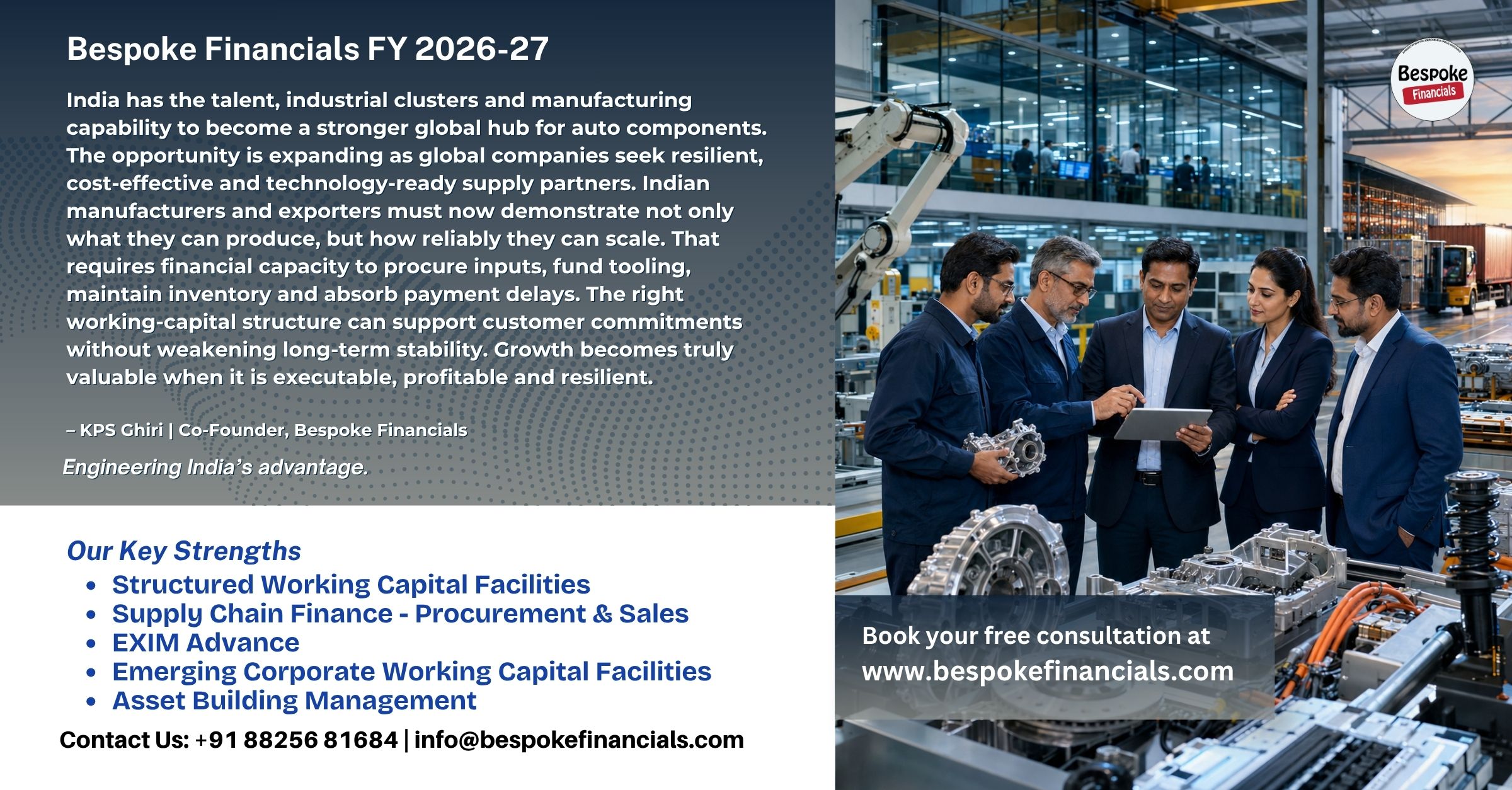
Bespoke Financials highlights the working-capital priorities shaping localisation, technology adoption, exports and growth in FY 2026–27
FOR IMMEDIATE RELEASE
Chennai, India | 2 August 2026
India’s auto-component industry is entering a decisive phase of expansion. As global automotive companies diversify their sourcing networks and vehicle manufacturers deepen localisation, Indian component manufacturers are being positioned not merely as cost-efficient suppliers, but as strategic partners in engineering, innovation, technology and global mobility.
This shift is creating significant opportunities for Indian manufacturers, traders and exporters of forgings, castings, machined components, braking systems, suspension parts, transmission assemblies, electrical systems, wiring harnesses, body and chassis parts, rubber products, plastic moulded components, precision parts and advanced electric-mobility systems.
However, the ability to win larger orders is no longer sufficient. Businesses must also possess the financial capacity to procure materials, invest in tooling, maintain inventory, upgrade technology, meet customer schedules and manage delayed receivables. For many companies, the central question for FY 2026–27 is not whether demand exists, but whether their liquidity structures are strong enough to convert demand into profitable and sustainable execution.
A Sector Moving from Manufacturing Capability to Strategic Global Relevance
India’s auto-component sector forms a critical part of the country’s manufacturing, mobility and export ecosystem. It supplies original equipment manufacturers, tier-one and tier-two automotive companies, passenger-vehicle manufacturers, commercial-vehicle producers, two-wheeler and three-wheeler companies, tractor and construction-equipment manufacturers, replacement markets and international aftermarket distributors.
Automotive manufacturing clusters across Chennai, Pune, Bengaluru, Gurugram-Manesar, Rajkot, Ahmedabad, Sanand, Hosur, Coimbatore, Nashik and other industrial locations have developed strong capabilities across machining, forging, casting, sheet-metal fabrication, plastics, electronics, tool manufacturing and precision engineering.
According to the Automotive Component Manufacturers Association of India (ACMA), the Indian auto-component industry recorded turnover of approximately ₹6.73 lakh crore in FY 2024–25, representing year-on-year growth of 9.6%. Supplies to OEMs reached approximately ₹5.70 lakh crore, while the aftermarket grew to nearly ₹99,948 crore. Exports increased by 8% to approximately US$22.9 billion, compared with imports of US$22.4 billion, resulting in a trade surplus of approximately US$453 million, according to ACMA’s FY 2024–25 industry performance review.
The sector also maintained momentum during the first half of FY 2025–26. ACMA reported industry growth of 6.8%, a 7.3% increase in supplies to OEMs and 9% growth in the aftermarket. Auto-component exports rose 9.3% to US$12.1 billion, although imports grew faster, resulting in a modest trade deficit during the period.
These developments demonstrate that Indian suppliers are steadily moving beyond conventional component assembly. Companies are increasingly participating in product development, design support, tooling, validation, testing, lightweighting, electronics integration, electric-vehicle systems and global replacement markets.
Domestic Demand and Global Sourcing Are Creating a Wider Growth Runway
The domestic automotive environment remains important to the sector’s outlook. The Society of Indian Automobile Manufacturers (SIAM) has reported strong performance across several vehicle categories, including passenger vehicles and commercial-vehicle exports.
For auto-component manufacturers, this translates into opportunities across both OEM and aftermarket channels. Vehicle manufacturers are introducing new models, expanding platforms and seeking more resilient supplier networks. They are also encouraging suppliers to increase production capacity, improve quality systems, strengthen traceability and support new technology requirements.
The aftermarket offers another important growth avenue. India’s expanding vehicle parc, increasing vehicle age, formalisation of workshops, organised retail and e-commerce distribution are supporting demand for replacement components. Companies with reliable product quality, efficient packaging, digital catalogues and dependable distribution can build recurring aftermarket revenue.
Global sourcing diversification is equally significant. International customers are evaluating Indian suppliers for quality, delivery, engineering support, value addition and production scalability. The India–UK Comprehensive Economic and Trade Agreement has identified engineering goods and auto components among the sectors expected to benefit from improved market access, subject to the applicable provisions and implementation of the agreement.
For Indian companies, these opportunities can support export diversification across North America, Europe, Asia, the Middle East, Africa and Latin America. However, international growth also requires strong documentation, product certification, origin compliance, traceability, logistics planning and financial preparation.
Localisation and New Mobility Are Reshaping Supplier Requirements
Localisation is becoming one of the important growth drivers for the Indian auto-component industry. OEMs and global suppliers are seeking alternatives to concentrated sourcing models and are increasingly interested in suppliers that can manufacture previously imported components, sub-assemblies and precision products.
Opportunities are emerging across powertrain components, braking systems, suspension parts, thermal-management systems, electrical assemblies, sensors, engineered plastics, castings, forgings and advanced materials.
The transition towards electric and connected mobility is creating additional demand for battery enclosures, electric-motor parts, power-electronics housings, wiring systems, connectors, thermal systems, lightweight structures and control components. Traditional suppliers with strong capabilities in machining, metal forming, plastics, electrical assemblies or precision inspection can reposition themselves through technology partnerships and product development.
The Production Linked Incentive scheme for automobiles and auto components is designed to strengthen domestic manufacturing of advanced automotive technology products and is applicable for the FY 2022–23 to FY 2026–27 period, subject to the scheme’s applicable guidelines and eligibility conditions.
The Financial Pressure Behind Growth
Despite strong opportunities, auto-component companies operate within a complex cash-flow environment.
OEM programmes may require suppliers to invest in moulds, dies, fixtures, testing systems, validation, quality certifications, production lines and dedicated manpower months before commercial revenue is fully realised. Purchase orders may also be released in stages, while suppliers are expected to maintain production readiness and safety stock.
Payment cycles can create a structural mismatch. A component manufacturer may dispatch products regularly but receive payment only after inspection, acceptance, invoice processing, reconciliation and the customer’s scheduled settlement cycle. During this period, the company must continue meeting obligations to raw-material vendors, employees, logistics providers, subcontractors and utilities.
Inventory requirements create an additional burden. Manufacturers may need to stock multiple grades of steel, aluminium, copper, rubber, polymers, fasteners, electronic components and packaging materials. Advance procurement can protect production schedules and reduce sourcing risk, but it also increases capital locked in inventory.
Exporters face pre-shipment and post-shipment funding requirements. Capital may be needed for production, packaging, inland transport, port charges, insurance, customs and documentation before export proceeds are received. A delay in shipment, buyer approval or overseas payment can extend the cash-conversion cycle.
Trading companies also require liquidity to purchase components in bulk, maintain availability across product categories and offer credit to distributors, retailers, workshops and institutional buyers.
Input-cost volatility adds further pressure. Steel, aluminium, copper, rubber, polymers, energy, fuel, chemicals, freight and imported electronics may experience price fluctuations that affect margins. If customer prices remain fixed while input prices rise, companies can face temporary margin compression even when order volumes are healthy.
Currency movements and international logistics add to the uncertainty. Exporters receiving US dollars, euros or pounds must manage the interaction between foreign-currency receipts, imported inputs and rupee-denominated operating costs.
Working Capital Is Becoming a Strategic Growth Lever
In this environment, working capital cannot be treated only as a facility for routine expenses. It is increasingly a strategic tool for growth, resilience and customer execution.
A properly designed working-capital structure can help an auto-component company:
- Procure raw materials at the right time.
- Maintain adequate production inventory.
- Fund tooling and customer-specific development.
- Meet OEM delivery schedules.
- Support export production and shipment cycles.
- Manage delayed receivables.
- Pay suppliers on time.
- Invest in capacity and technology.
- Accept larger orders without destabilising routine operations.
The key is alignment. The tenure, amount, repayment method and funding route must correspond to the actual business cycle. A short-cycle procurement requirement should not be unnecessarily burdened with an unsuitable long-term structure, while recurring receivable gaps should not be addressed through irregular and expensive emergency borrowing.
Bespoke Financials: Sector-Aware Financial Support Since 2016
Since 2016, Bespoke Financials has been supporting entrepreneurs, MSMEs, SMEs, manufacturers, traders, exporters and emerging corporates with structured financial solutions aligned with their operating requirements.
The company’s approach is based on understanding the business behind the numbers. For auto-component clients, this includes evaluating OEM relationships, order visibility, customer concentration, procurement cycles, inventory movement, tooling requirements, receivable ageing, export terms, margin profile, existing obligations and expansion plans.
This domain understanding is particularly important for auto-component businesses because a conventional financial assessment may not fully capture the strength of a company’s manufacturing capability, customer relationships, purchase orders, technical competence or future growth potential.
Bespoke Financials positions itself as a strategic financial partner rather than simply a source of capital. Its role is to help businesses identify suitable funding structures, prepare their financial requirements, evaluate cash-flow needs and pursue growth with greater liquidity discipline.
Working Capital and Financial Facilities Available for FY 2026–27
Bespoke Financials states that it offers a range of facilities that may support different requirements across the auto-component value chain, subject to eligibility, due diligence, credit assessment, applicable regulations and mutually agreed terms:
- Working Capital (Non-Asset-Based) – Up to ₹20 Cr: Structured liquidity for inventory, receivables, production, operating expenses and business expansion without depending entirely on conventional collateral.
- Supply Chain Finance (No Collateral) – Up to ₹50 Cr: Funding support linked to supplier payments, buyer relationships and procurement cycles, subject to applicable eligibility and assessment.
- Export & Import Finance – Up to $5M: Support for imported inputs, pre-shipment production, shipment costs, customs, documentation and overseas receivables.
- Agri Trade Finance: Available for eligible businesses operating in agricultural, allied or agri-processing trade activities connected with wider industrial ecosystems.
- Merchant Cash Advance: Suitable for eligible aftermarket distributors, e-commerce component sellers and retail-infrastructure businesses with recurring collections.
- Traditional / Quick Capital: Flexible funding options for eligible businesses with urgent procurement, order execution, operational continuity and time-sensitive requirements.
- Equity-Based Working Capital – ₹25 Cr+: Growth-oriented capital for eligible companies undertaking significant expansion, capacity creation or strategic development.
- Emerging Corporate Finance – Up to ₹15 Cr: Structured financial support for established and growing companies, subject to assessment and eligibility.
- Procurement Facility – Bank Guarantee-backed, up to 270 days: Support for procurement commitments where suppliers require bank-guarantee-backed comfort and extended settlement terms.
- Working Capital Against Negotiable Instruments – Up to ₹20 Cr for short periods up to 10 months: Short-term liquidity against eligible negotiable instruments for defined cash-flow gaps.
- Working Capital (Non-Asset-Based) – Up to ₹20 Cr with bullet repayment methods: Funding structures that may be aligned with identifiable order realisations or receivable inflows, subject to assessment and applicable pricing.
- Asset Restructuring with Additional Working Capital Facilities from ₹10 Cr and above: Support for eligible businesses seeking to reorganise existing obligations while creating additional operational liquidity.
The objective is responsible financial enablement. Bespoke Financials’ approach is to assess the actual requirement and align the facility with the company’s order cycle, cash-conversion period, repayment source and business objectives.
Client Experiences: Funding Linked to Real Operating Requirements
The following anonymised examples, as described by Bespoke Financials, illustrate situations in which sector-specific financial planning may support business requirements:
A Tamil Nadu-based auto-component manufacturer had secured an additional OEM order but required funding for tooling and raw-material procurement before the first customer payment. Bespoke Financials evaluated the timing gap and helped structure working capital around the production cycle. The company was able to begin manufacturing on schedule and avoid delaying the customer programme.
A precision engineering exporter from Maharashtra experienced longer overseas buyer-approval and payment cycles while continuing to meet domestic vendor obligations. Bespoke Financials helped evaluate export-linked and receivable-based funding options, enabling the company to manage shipment costs, maintain payment discipline and accept repeat export orders.
A tier-two supplier in Gujarat had strong manufacturing capability and customer potential, but its existing funding structure did not adequately reflect its operating cycle. Bespoke Financials reviewed the company’s business profile and helped explore a more suitable structure for procurement and capacity expansion. The additional liquidity improved vendor confidence and strengthened the company’s readiness for larger customer programmes.
These anonymised situations demonstrate the importance of sector-specific financial analysis. The appropriate facility is not determined only by turnover or fixed assets; it must also reflect customer relationships, production cycles, receivable visibility, inventory requirements and growth plans.
Deep Domain Knowledge as a Practical Advantage
Bespoke Financials’ experience across manufacturing, trading and exporting businesses enables it to understand the practical issues that influence funding decisions.
- The difference between OEM, aftermarket and export cash-flow cycles.
- The impact of tooling and customer-specific development costs.
- The working-capital pressure created by advance raw-material procurement.
- The importance of supplier payment continuity.
- The effect of delayed receivables on production planning.
- The funding requirements associated with export documentation and shipment.
- The role of buyer concentration and payment history.
- The significance of technology investment and capacity expansion.
- The difference between temporary liquidity needs and permanent capital requirements.
This understanding can help clients present their business more effectively and identify a funding structure that is better aligned with operational reality.
Building a Stronger and More Competitive Auto-Component Ecosystem
India’s auto-component industry contributes to a wide network of manufacturing and service activities, including steel, aluminium, rubber, chemicals, plastics, electronics, engineering, tool rooms, logistics, testing, packaging, automation and maintenance services.
The sector supports employment across production, design, quality control, planning, logistics, finance, sales and technical services. It also creates opportunities for ancillary businesses operating around automotive clusters.
The next stage of development will depend on the ability of companies to invest in quality systems, automation, digital traceability, sustainable production, advanced materials, testing capabilities and new mobility products.
Companies that combine technical strength with disciplined financial planning will be better positioned to capture the benefits of localisation, export diversification, aftermarket growth, new mobility and supplier consolidation.
A Message from KPS Ghiri, Co-Founder, Bespoke Financials
“India’s auto-component industry has the capability, talent and industrial ecosystem to become a stronger global manufacturing and sourcing partner. The opportunity is significant, but growth must be supported by financial readiness. A company may have a strong order book, excellent production capability and reliable customers, yet still face pressure if procurement, tooling, inventory and receivables are not funded in the right manner.
“At Bespoke Financials, we believe that working capital should be structured around the real business cycle. Our objective is to understand the company’s operations, customer relationships and growth plans before identifying suitable financial solutions. Since 2016, we have worked with businesses across India to support liquidity, expansion and responsible execution.”
Why Businesses Choose Bespoke Financials
Bespoke Financials has been operating since 2016 and states that it has served more than 4,500 businesses across India. Its approach combines tailored financial structuring, sector knowledge, responsive processing and a focus on business objectives.
The company’s key strengths include:
- Tailored solutions: Financial structures aligned with business goals and operating cycles.
- Domain knowledge: Understanding of manufacturing, trading, exporting, procurement, inventory and receivable requirements.
- Flexible funding: Solutions designed for different business stages and cash-flow needs.
- Swift processing: Responsive evaluation for time-sensitive commercial requirements.
- Strategic partnership: Support for leadership teams planning growth, expansion and liquidity management.
- Recognition: The company states that it received the Excellence in Fintech Innovation award for FY 2024–25.
Conclusion
India’s auto-component industry is entering a period of substantial opportunity. Localisation, electric mobility, export diversification, aftermarket growth, technology adoption and supplier consolidation can create a stronger platform for Indian manufacturing.
However, the companies that benefit most will not necessarily be those with the largest order books. They will be the businesses capable of converting orders into timely production, consistent quality, dependable delivery and profitable cash flow.
Financial readiness must therefore become part of the strategic agenda for auto-component manufacturers, traders and exporters. The right working-capital structure can help businesses procure materials, invest in tooling, support technology upgrades, manage receivables, strengthen vendor relationships and accept larger customer programmes.
Bespoke Financials invites auto-component businesses planning capacity expansion, new customer onboarding, raw-material procurement, export execution, technology investment or working-capital enhancement during FY 2026–27 to initiate a confidential discussion.
Phone: 8825681684
Email: info@bespokefinancials.com
Website: www.bespokefinancials.com
About Bespoke Financials
Established in 2016, Bespoke Financials is a strategic financial partner supporting entrepreneurs, MSMEs, SMEs, manufacturers, traders, exporters, emerging corporates and established enterprises across India. The company focuses on customised working-capital solutions, structured finance, supply-chain finance, export-import finance and growth-oriented liquidity facilities aligned with business operations.
Disclaimer: All financial facilities mentioned in this release are subject to eligibility, due diligence, credit assessment, applicable regulatory requirements and the terms and conditions of the respective facility provider. Funding limits and availability may vary based on individual business profiles and assessment.