NHRC Steps In After Amravati Hospital Fire Raises Serious Questions on Newborn Safety
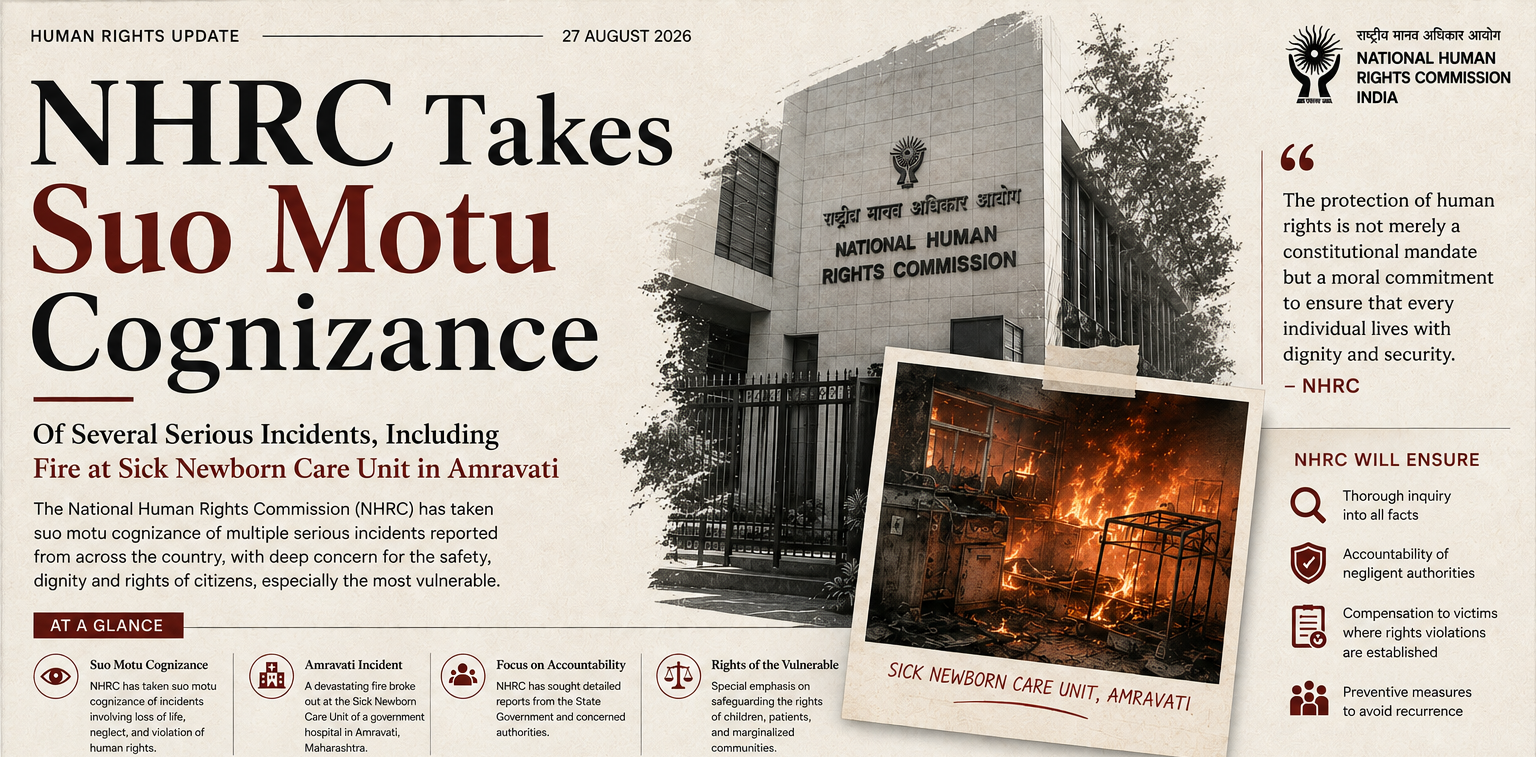
The National Human Rights Commission (NHRC) has taken suo motu cognizance of the deaths of three newborns and injuries to four others following a fire at the Sick Newborn Care Unit (SNCU) of the District Women’s Hospital in Amravati, Maharashtra. The incident has prompted renewed scrutiny of fire safety, emergency preparedness and the protection of critically ill newborns in public hospitals.
Fire at Amravati newborn care unit
The tragedy occurred in the early hours of August 24, 2026, at the hospital’s Sick Newborn Care Unit, where vulnerable infants were receiving specialised treatment. The fire reportedly broke out at around 3.30 am. Initial reports have indicated a ventilator as a possible source, although the precise cause remains subject to investigation.
The affected unit was situated on the third floor of the hospital’s newer building. Newborn-care units present particular challenges during emergencies because many patients are dependent on incubators, ventilators and other life-support equipment and cannot be evacuated without medical assistance.
The incident therefore raised immediate concerns not only about the cause of the fire but also about whether emergency systems, evacuation arrangements and fire-prevention measures were adequate for a high-risk medical environment.
Rescue operation saves dozens of newborns
Hospital doctors, nurses and other staff began evacuating babies after the fire was detected. Reports indicate that 36 infants were rescued and shifted to safer areas of the hospital.
However, the emergency resulted in the deaths of three newborns, while four others sustained injuries. The babies who died were reportedly between two and ten days old. The circumstances surrounding their deaths included the effects of the fire and smoke.
For the families, the incident represents an especially devastating loss. Parents who had brought their newborn children to hospital for specialised treatment instead faced an emergency in which their children were among the most vulnerable people inside the building.
NHRC seeks detailed report from Maharashtra
The NHRC has now sought answers from the Maharashtra government. The Commission issued a notice to the Maharashtra Chief Secretary and sought a detailed report within two weeks.
The Commission has asked for information concerning the condition of the injured newborns and the compensation announced for the families affected by the tragedy. The intervention places the incident within a broader human-rights framework, particularly the state's responsibility to protect life and dignity.
An investigation into the fire itself will be important, but questions of accountability extend further. Authorities will need to establish whether safety equipment was functioning, whether emergency procedures were followed and whether any technical, administrative or infrastructural shortcomings contributed to the deaths.
Hospital fire safety under renewed scrutiny
The Amravati hospital fire has once again focused attention on fire preparedness in government healthcare institutions across Maharashtra.
The state has undertaken fire-safety audits of public health facilities following previous hospital tragedies. However, the latest incident highlights the distinction between having safety systems formally installed and ensuring that those systems remain operational and that staff are prepared to respond immediately when an emergency occurs.
Fire alarms, electrical installations, extinguishing systems, emergency exits, evacuation routes and staff training all become critical when a fire occurs inside a neonatal or intensive-care unit.
For newborn-care facilities, safety planning requires additional safeguards because patients may be unable to breathe independently, move without assistance or survive without specialised equipment.
Memories of earlier neonatal tragedies
The Amravati incident has also revived memories of the devastating 2021 fire at a Sick Newborn Care Unit in Bhandara, Maharashtra, where ten newborns died.
That tragedy prompted wider discussions about fire audits and safety systems in hospitals. The recurrence of a fatal fire involving newborn patients has consequently intensified calls for authorities to examine whether lessons from earlier incidents have been fully implemented.
The central issue is not simply preventing fires. Hospitals must also be prepared for rapid evacuation when prevention measures fail. In a neonatal unit, every minute can determine whether a critically ill infant survives.
What happens next
The next stage will depend on the findings of the investigations and the Maharashtra government's response to the NHRC notice. Authorities are expected to examine the circumstances surrounding the fire, the functioning of safety equipment and the hospital's emergency response arrangements.
The condition of the injured newborns and support for the bereaved families will also remain important concerns. Compensation can provide immediate assistance, but families and the wider public will ultimately seek accountability and meaningful preventive measures.
The Amravati hospital fire is a stark reminder that medical treatment cannot be separated from patient safety. The NHRC's intervention places renewed attention on accountability, emergency preparedness and stronger safeguards for newborns in healthcare facilities.
Primary keyword: Amravati hospital fire
Related keywords: NHRC Amravati, Sick Newborn Care Unit fire, newborn deaths in Amravati, hospital fire safety Maharashtra
---