Ultra-Luxury Real Estate: Is a Small Land Parcel Enough to Define Luxury?
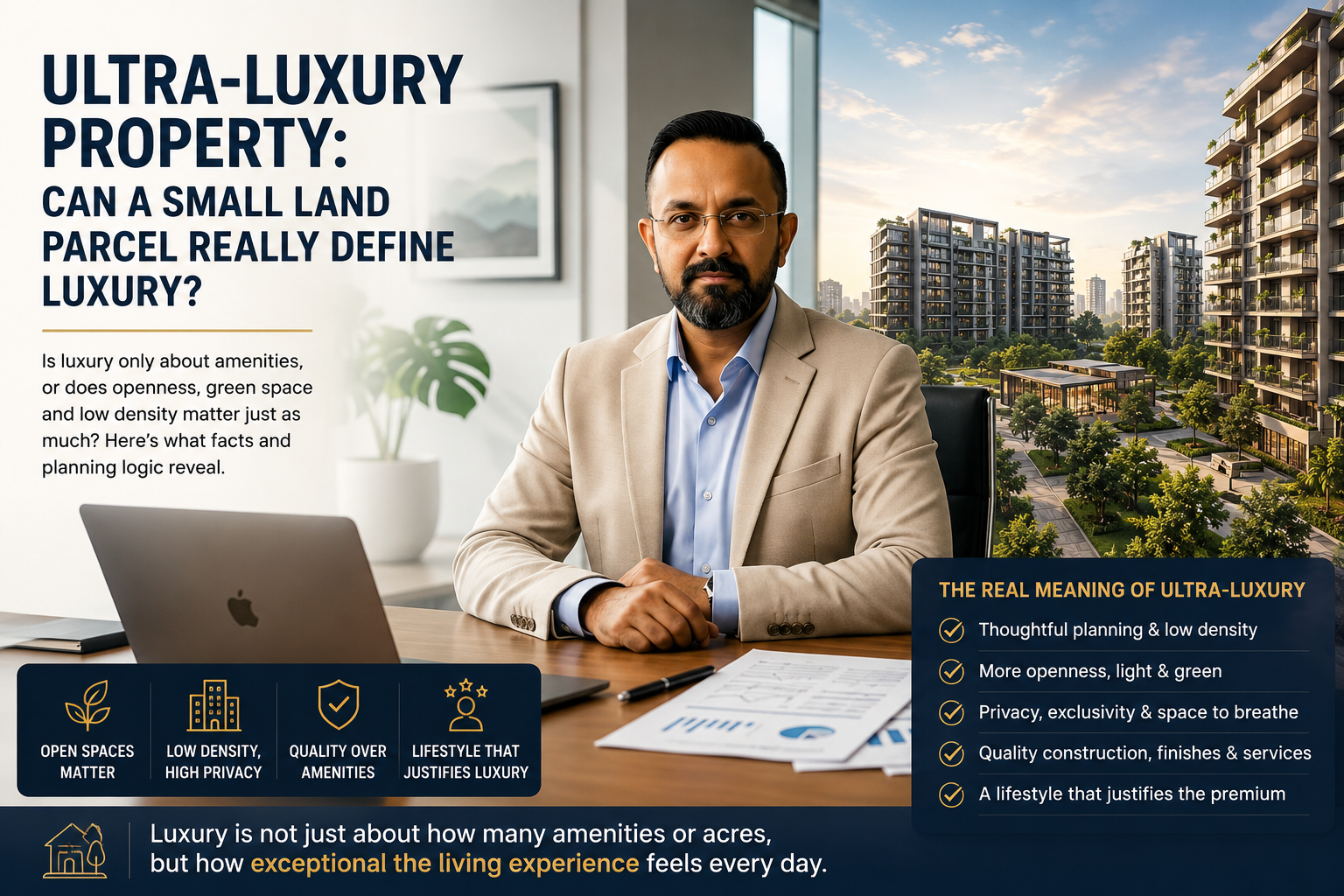
As India’s luxury housing market continues to expand, the term “ultra-luxury” is increasingly being used across residential projects, particularly in major markets such as Delhi-NCR, Mumbai, Bengaluru and Hyderabad. But an important question deserves greater scrutiny: Can a residential development genuinely be called ultra-luxury merely because it offers premium amenities on a land parcel of two acres or less?
The answer is not straightforward. Land size, amenities, construction quality, privacy, density, landscaping and the relationship between built-up and open areas all contribute to the overall perception of luxury. There is no universally prescribed legal definition in India stating that an “ultra-luxury” residential project must be developed on a particular minimum or maximum land parcel.
Land Size Alone Does Not Define Ultra-Luxury
A two-acre development can certainly contain an exceptionally expensive and sophisticated residence. However, a smaller land parcel can also create limitations, particularly when a developer attempts to accommodate a large number of apartments, extensive amenities, parking, services and landscaping within a constrained site.
The real question, therefore, is not simply “how many acres?” but how the available land is planned and experienced by the resident.
For example, a project may offer a private clubhouse, swimming pool, gym, spa, concierge services, lounges and multiple recreational facilities. These features may enhance the lifestyle proposition, but they do not automatically establish ultra-luxury.
Luxury is ultimately about quality, exclusivity and the overall experience delivered to the buyer, rather than simply the number of amenities listed in a brochure.
Is Openness the Missing Ingredient?
This is where land planning becomes particularly important.
In high-density urban markets, genuine open space is increasingly valuable. Consequently, expansive views, landscaped gardens, low-density planning, private terraces, balconies, natural light, ventilation and visual separation from neighbouring buildings can become luxury attributes in their own right.
Industry research has also highlighted growing buyer interest in private balconies, wellness and privacy-oriented features, suggesting that the definition of contemporary luxury is moving beyond visible opulence towards well-being, privacy and openness.
Amenities Versus Actual Living Experience
A project can have 30 or 50 amenities and still feel congested if a significant portion of the site is occupied by towers, driveways, parking and supporting infrastructure.
Conversely, a comparatively smaller amenity portfolio can feel significantly more luxurious when residents enjoy:
Lower residential density
Generous landscaped areas
Greater distance between buildings
Private or semi-private outdoor spaces
Natural light and ventilation
Quality construction and finishes
Privacy and controlled access
Efficient services and maintenance
Thoughtful architecture and planning
Under RERA, common areas may include various shared spaces within a project, such as parks, play areas, open parking and community facilities. This reinforces an important distinction: the existence of common space is not necessarily the same as the quality or proportion of genuinely usable open space.
What Should Buyers Examine?
Buyers evaluating an “ultra-luxury” project should look beyond the marketing terminology.
The more meaningful questions are: How much of the site remains open? How much is landscaped? What is the number of residences? What is the tower density? How much private outdoor space does each residence receive? How much distance exists between buildings? What are the views, privacy levels and natural-light conditions?
These factors can provide a more meaningful indication of luxury than an amenity-counting exercise.
The distinction is particularly relevant as India’s premium housing market continues to grow. Industry reports have highlighted strong growth in the value and volume of premium and luxury housing sales across major Indian cities, reflecting increasing demand from high-value homebuyers.
The Real Meaning of Ultra-Luxury
Ultra-luxury should ideally be judged by the quality of the entire living ecosystem—not merely the land parcel or amenity list.
A small land parcel can support an ultra-luxury project if it is intelligently planned, highly exclusive, low-density and delivers exceptional privacy, architecture, materials and services. But if a limited site is packed with towers and amenities primarily for marketing impact, calling it ultra-luxury can become more of a positioning strategy than a meaningful measure of lifestyle quality.
In the evolving Indian luxury housing market, space itself is becoming a premium amenity. Open skies, greenery, privacy, quietness and breathing room may ultimately be more valuable to a discerning buyer than another clubhouse feature.
Therefore, the more logical definition of ultra-luxury is not “How many acres?” or “How many amenities?”, but rather:
How exclusive, spacious, private, well-planned and exceptional is the living experience created from those acres?