India’s technology story is no longer limited to software companies, start-up founders, global IT hubs, or billion-dollar digital platforms. It has moved far beyond glass offices and urban innovation centres. Today, technology is quietly entering the lanes of small towns, the classrooms of government schools, the hands of farmers, the shops of local vendors, and the homes of ordinary Indian families.
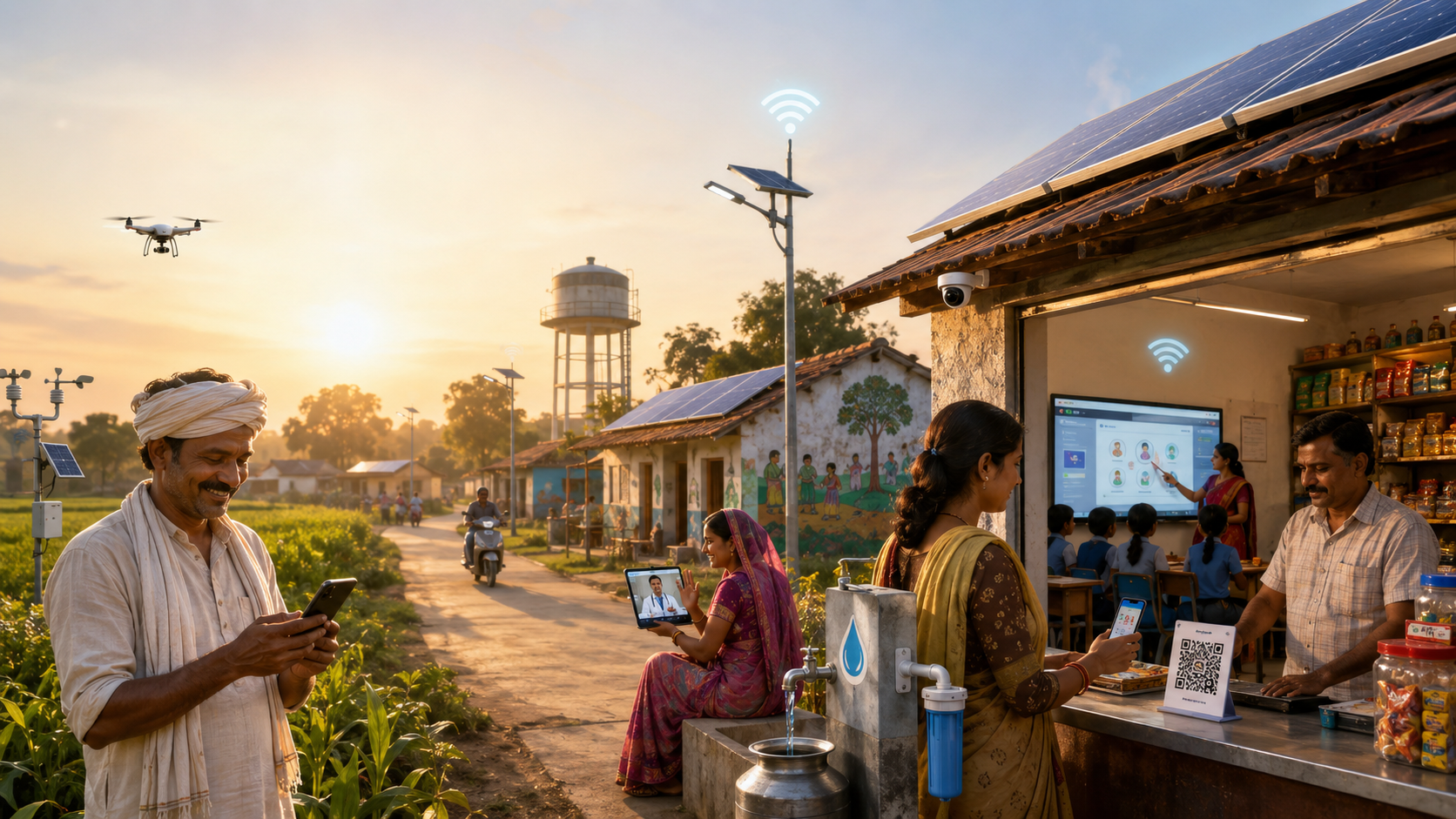
What makes India’s technology journey unique is not just its scale, but its reach. In many countries, technology first changes the lives of the privileged. In India, its real success lies in the fact that it is slowly becoming a tool of inclusion. A farmer can check market prices on his phone. A small shopkeeper can accept payments digitally. A student in a village can attend online classes. A homemaker can access government documents without standing in long queues. A migrant worker can send money home instantly.
This is the new face of Digital India: not just a nation using technology, but a nation being transformed by it.
Over the last few years, digital payments, smartphones, affordable data, online education, telemedicine, e-governance, and digital identity systems have changed how Indians live and interact. A country once known for paperwork, queues, and middlemen is now moving toward faster, more transparent, and more accessible services.
But the most powerful part of this transformation is visible in rural India.
For decades, villages were seen as places that waited for development to arrive. Roads, electricity, schools, healthcare, and clean water were considered the basic markers of progress. Today, the idea of development has expanded. Connectivity, digital classrooms, online access, surveillance systems, clean water technology, and digital governance are becoming equally important.
A strong example of this change can be seen in Punsari, a village in Gujarat that became widely known as one of India’s early smart village models.
Punsari’s story stands out because it challenges a common assumption: that modern technology belongs only to cities. The village adopted facilities such as Wi-Fi connectivity, CCTV cameras, digital classrooms, water purification systems, better local transport, and improved public infrastructure. These were not introduced as showpieces. They were used to solve real problems.
CCTV cameras helped improve safety. Digital tools supported education. Clean drinking water systems improved daily life. Better connectivity opened access to information. Technology became a practical part of governance and community development.
What makes Punsari inspiring is not just the presence of technology, but the way it was integrated into village life. It showed that a village does not become advanced simply by installing devices. It becomes advanced when technology improves people’s lives in visible, meaningful ways.
A child studying in a digitally enabled classroom is not just using a screen; she is gaining exposure to a world beyond her geography. A family getting access to purified drinking water is not just receiving a service; it is experiencing better health and dignity. A villager using digital systems is not just adopting technology; he is becoming part of a more connected India.
This is where India’s true technology opportunity lies.
The future of the country will not be decided only by artificial intelligence, semiconductors, fintech, or start-ups. These are important, but the deeper question is this: can technology improve the life of the common Indian?
Can it help a farmer earn better?
Can it help a student learn better?
Can it help a patient consult a doctor faster?
Can it help a small business grow?
Can it help citizens access services without depending on influence or middlemen?
If the answer is yes, then technology is not just innovation. It is empowerment.
India has a rare advantage. It has a young population, affordable internet, a fast-growing digital economy, and a society that adapts quickly when technology solves a real problem. The success of digital payments is proof. What once seemed difficult for millions of people has now become a daily habit. From a vegetable vendor to a cab driver, from a roadside tea stall to a premium retail store, digital transactions have become normal.
This shift is not just about convenience. It is about confidence.
When people begin to trust technology, they begin to use it for more important things: education, health, business, savings, identity, and opportunity. That is when a digital habit becomes a development tool.
However, India’s technology journey is not without challenges. Digital access still needs to become more equal. Many rural users need better digital literacy. More platforms need to be available in Indian languages. Cyber safety and data privacy must become part of everyday awareness. Technology must be simple enough for first-time users and strong enough to protect them.
The next phase of India’s growth will depend on how well technology is designed for Bharat, not just for urban India. The real test is not whether a person in a metro city can use an app. The real test is whether a villager, a farmer, a small trader, a student, or an elderly citizen can use it with confidence.
That is why stories like Punsari matter. They remind us that progress does not always begin in boardrooms. Sometimes, it begins in a village that decides to think differently.
Technology has the power to reduce distance—not just physical distance, but social and economic distance. It can bring a government service closer to a citizen, a teacher closer to a student, a doctor closer to a patient, and a market closer to a farmer.
India’s technology revolution is not just about becoming a digital superpower. It is about becoming a more equal, efficient, and aspirational society.
The real beauty of this transformation is that it is not happening in one place. It is happening everywhere. In cities, it is driving innovation. In towns, it is creating new businesses. In villages, it is opening new possibilities.
Technology in India is no longer a symbol of privilege. It is becoming a bridge. A bridge between urban and rural. Between access and opportunity. Between today’s limitations and tomorrow’s possibilities.
And perhaps that is India’s biggest achievement: not that it has adopted technology, but that it is learning to use technology to change lives.
The future of India will not be built only in technology parks. It will also be built in villages, classrooms, farms, local shops, and homes where digital tools are giving people the power to dream bigger.
Punsari is not just a smart village story. It is a glimpse of what India can become when technology reaches the last mile.
A smarter India will not be defined only by faster internet or newer apps. It will be defined by better lives.
And that is the real promise of technology in India.