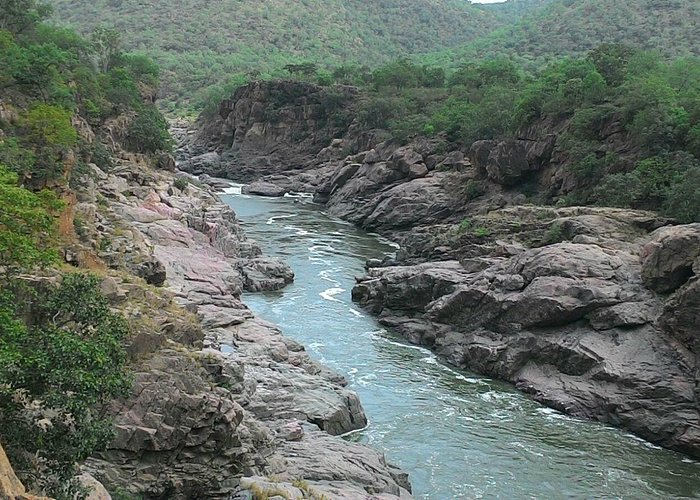
The proposed Mekedatu Balancing Reservoir and Drinking Water Project, designed to secure Bengaluru’s water future, has become a fierce battleground between Karnataka and Tamil Nadu. For Karnataka, the ₹9,000-crore, 67.16 TMC capacity dam is a vital infrastructure necessity. For Tamil Nadu, the lower riparian state, the project is viewed as an existential threat to its agriculture, drinking water supply, and legal rights over the Cauvery River. As the dispute intensifies in mid-2026, here is an in-depth look at what the Mekedatu project means for Tamil Nadu.
The Chokehold on Natural Flows
The Cauvery River’s flow into Tamil Nadu relies heavily on the uncontrolled catchment areas downstream of Karnataka’s existing reservoirs, primarily the Krishna Raja Sagar (KRS) and Kabini dams. Tamil Nadu argues that constructing a massive balancing reservoir at Mekedatu—just before the river enters its borders—will effectively give Karnataka a chokehold on this natural flow. The state fears that Karnataka will intercept and store water meant for Tamil Nadu, releasing it only at its own discretion, which could be catastrophic during distress years of low rainfall.
The Threat to the “Rice Bowl”
Tamil Nadu’s Cauvery delta is the agricultural heartbeat of the state, affectionately known as its “rice bowl.” Millions of farmers depend almost entirely on timely and adequate water releases from the river for irrigation. Agricultural associations have consistently raised alarms that the Mekedatu dam could dry up this region. It is estimated that the disruption in water flow could threaten the cultivation of 25 lakh acres of fertile land, plunging the livelihoods of delta farmers into deep uncertainty and potentially turning productive areas into barren expanses. A Looming Drinking Water Crisis Beyond agriculture, the Cauvery River is the primary drinking water lifeline for a massive segment of Tamil Nadu’s population. Water sourced from the river supports an estimated 5 crore (50 million) people across 32 districts in the state. By potentially reducing the volume of water flowing into Tamil Nadu, the Mekedatu project directly threatens the drinking water security of these districts, heightening the risk of severe shortages during the dry months.
A Contested Legal Landscape
Tamil Nadu maintains that the construction of the dam is fundamentally illegal. The state argues that the Cauvery basin is already water-deficient and fully allocated by the Cauvery Water Disputes Tribunal (CWDT) in its 2007 final award. Furthermore, Tamil Nadu cites the landmark February 2018 Supreme Court judgment, which stipulates that upper riparian states cannot undertake projects that alter the scheduled delivery of water to lower riparian states without explicit consent. However, the legal fight has faced recent hurdles. In April 2026, the Supreme Court dismissed a review petition filed by Tamil Nadu, calling the state’s challenge “premature.” The Court noted that Karnataka’s Detailed Project Report (DPR) is still under review by expert bodies like the Central Water Commission (CWC) and the Cauvery Water Management Authority (CWMA), meaning no final approval has been granted yet. The Escalating Political Standoff The issue has sparked intense political mobilization in 2026. Following the Supreme Court’s dismissal, newly sworn-in Tamil Nadu Chief Minister C. Joseph Vijay held high-level consultative meetings in May with legal luminaries and Cauvery experts, directing officials to expedite all possible legal recourse. He subsequently met with Prime Minister Narendra Modi in Delhi, strongly urging the Centre to reject Karnataka’s DPR.
Simultaneously, tensions on the ground are boiling over. Farmer organizations, leading massive rallies near the Tamil Nadu-Karnataka border in places like Hosur, have demanded that contempt of court proceedings be initiated against Karnataka leaders pushing for the dam. As Karnataka pushes forward with intentions to construct the dam, Tamil Nadu is digging in its heels, bracing for a protracted legal and political fight to protect its water rights.