The Silent Scorcher: How El Niño Fuels India’s Deadly Heat Waves
As the global climate shifts, the phrase El Niño has moved from meteorology textbooks to daily headlines. For India, this isn’t just a distant oceanic shift; it is a primary driver of record-breaking temperatures and prolonged dry spells that test the nation’s resilience.
What is the El Niño Phenomenon?
At its core, El Niño is a climate pattern involving the unusual warming of surface waters in the eastern tropical Pacific Ocean. While it happens thousands of miles away, its ripple effects disrupt global atmospheric circulation.
The Mechanism
In a “normal” year, trade winds blow west across the Pacific, pushing warm water toward Asia. During El Niño, these winds weaken or even reverse. This allows the warm water to surge back toward the Americas.
For India, this shift is problematic. It disrupts the Walker Circulation, which typically brings moisture-rich air to the Indian subcontinent. Instead, the sinking limb of this atmospheric loop settles over India, suppressing cloud formation and leading to:
Reduced rainfall (Monsoon deficits).
Clearer skies that allow more solar radiation to hit the ground.
Persistent high-pressure systems that “trap” heat.
The Heat Wave Connection
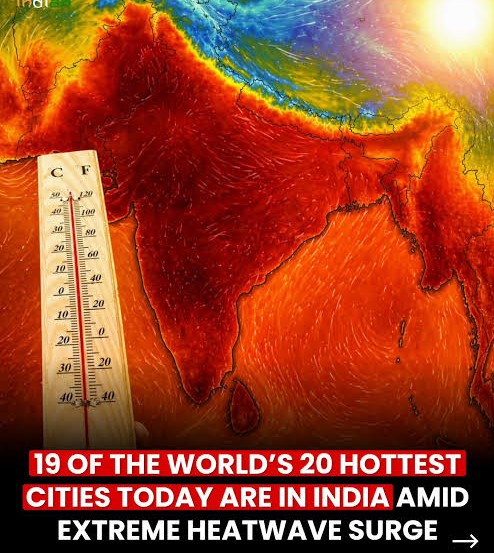
A heat wave in India is officially declared when temperatures reach at least 40°C in the plains or 30°C in hilly regions, with a departure of 4.5text{°C} to 6.4text{°C} from the normal.
How El Niño amplifies this:
Early Onset: El Niño years often see “premature” summers, with heat waves beginning as early as March.
The “Anti-Cyclone” Effect: El Niño often triggers anti-cyclonic circulations over the Bay of Bengal. These move inland, bringing dry, hot air from the northwest (the Thar Desert and Pakistan) into Central and Eastern India.
Suppressed Pre-Monsoon Showers: Usually, “Kalbaishakhi” or “Mango Showers” provide brief relief in April and May. El Niño-induced dryness eliminates these cooling breaks.
Impact on the Ground
The synergy between El Niño and heat waves creates a multi-sectoral crisis:
Agriculture: Soil moisture evaporates rapidly, threatening “Kharif” (summer) crop sowing.
Public Health: Increased cases of heatstroke, dehydration, and cardiovascular stress. The Wet Bulb Temperature (a measure of heat plus humidity) often nears the limit of human survivability (35text{°C}).
Energy Demand: Power grids face immense pressure as air conditioning and irrigation pump usage spikes, often leading to coal shortages and blackouts.
The Climate Change Multiplier
It is important to note that El Niño is a natural cycle, but Global Warming acts as a force multiplier. While El Niño provides the “push,” the baseline temperature of the Earth is already higher. This means that a “strong” El Niño today produces far more catastrophic heat than a “strong” El Niño did in the 1980s.
Key Statistic: Historical data shows that about 60% of drought years in India since 1950 have coincided with El Niño events, almost always accompanied by severe heat waves.
Looking Ahead: Adaptation
As these events become more frequent, India is pivoting toward Heat Action Plans (HAPs). These include:
Cool Roof initiatives to lower indoor temperatures.
Early Warning Systems via SMS and local media.
Changing outdoor work hours for laborers to avoid the 12text{ PM} – 4text{ PM} window.
Understanding El Niño is no longer just for scientists—it’s a crucial part of India’s survival strategy in a warming world.