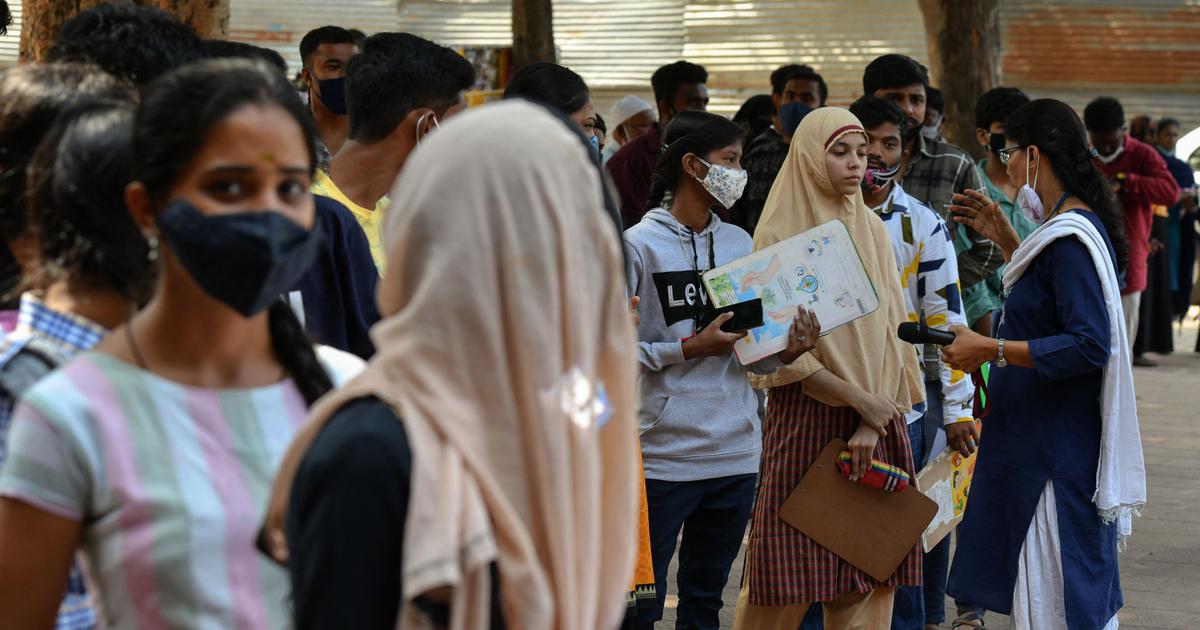
The Karnataka government has taken a significant step by revoking the controversial hijab ban that was imposed during the tenure of the previous Bharatiya Janata Party (BJP) administration. This decision, announced on Wednesday, replaces the 2022 order with a new directive that permits students to wear specific traditional and faith-based symbols alongside their school uniforms, marking a notable shift in the state’s approach to religious expression in educational institutions.
The prior regulation, enacted under Chief Minister Basavaraj Bommai’s leadership, had effectively prohibited hijabs in schools and colleges that mandated uniforms. The directive stated that students were only allowed to wear uniforms prescribed by their respective institutions, and in cases where uniforms were not specified, any clothing deemed to disturb the principles of “equality, integrity, and public law and order” was also banned. This controversial policy had its roots in an incident at a government college in Udupi, where six girls were barred from attending classes for wearing headscarves.
The enforcement of this ban sparked widespread protests across Karnataka, as students rallied for their right to wear hijabs in educational settings. The situation escalated to a legal battle, with the affected students challenging the ban in the Karnataka High Court, which upheld the prohibition by asserting that the hijab was not an essential tenet of Islam. This decision was met with further dissent and was subsequently contested in the Supreme Court, where a split verdict was issued in October 2022, leaving the issue unresolved.
As the state government navigated the complexities of the hijab controversy, the recent amendment to the directive signals a more inclusive approach. The allowance of limited religious symbols aligns with the cultural diversity inherent in Karnataka and acknowledges the rights of students to express their faith while adhering to uniform policies. This change may serve to ease tensions that have arisen over the past few years and reflects a growing recognition of the importance of religious freedom in educational contexts.
In a time when debates around secularism and religious expression are increasingly relevant in India, Karnataka’s new directive sets a precedent that could influence other states grappling with similar issues. As educational institutions strive to maintain order while respecting personal beliefs, the dialogue surrounding the intersection of tradition and modernity continues to evolve. The latest move by the Karnataka government could pave the way for a more harmonious coexistence of faith and education, fostering an environment where students can embrace their identity without compromising their right to education.