Manipuri and Bishnupriya Manipuri: Differences, Relationship, Awareness, and the Nalugaon Incident
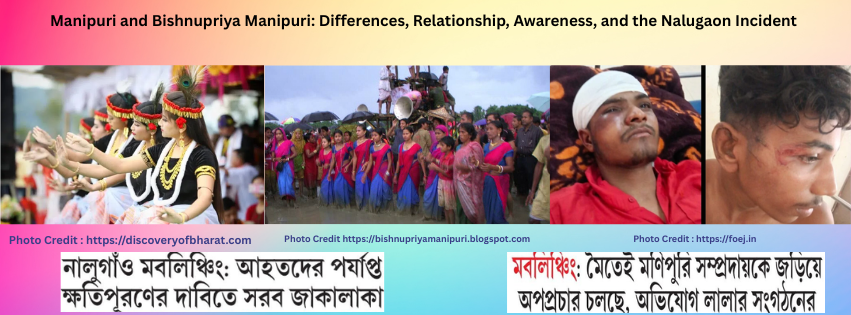
Manipuri and Bishnupriya Manipuri: Differences, Relationship, Awareness, and the Nalugaon Incident
The term “Manipuri” generally refers to the people, language, culture, and heritage associated with the state of Manipur. However, in the context of Assam, the term has a broader and historically significant meaning.
Historically, many people migrated from Manipur to Assam and neighboring regions at different times. Particularly during the 18th and 19th centuries, wars, political changes, and various social circumstances increased such movements. However, this was not the only reason. Long before that, matrimonial alliances existed between the royal families of Manipur and the royal houses of Cachar, Ahom, and Tripura.
Through these relationships, many Manipuris settled permanently in different regions. As a result, in Assam, the identity of “Manipuri” evolved into an important social and historical identity rather than merely a geographical label.
In the context of Assam, the term “Manipuri” generally refers to those who speak the Manipuri or Meitei language. This identity primarily includes the Meitei, Meitei Brahmins, and Meitei Pangals (Manipuri Muslims). Historically and socially, these groups have been collectively recognized as “Manipuri.”
At the same time, the Bishnupriya Manipuri community also shares a historical connection with the broader Manipuri identity in Assam. Although there are differences in language, religion, and certain cultural characteristics, their historical roots are also connected with Manipur.
Linguistically, Manipuri or Meitei is recognized in the Eighth Schedule of the Constitution of India and belongs to the Tibeto-Burman branch of the Sino-Tibetan language family. It is the official language of the state of Manipur and serves as its principal language of communication.
On the other hand, the Bishnupriya Manipuri language belongs to the Bengali-Assamese branch of the Indo-Aryan language family, although it also contains influences from older forms of Manipuri. According to many scholars, the Meitei people are the indigenous and principal inhabitants of the Manipur Valley, with a history extending back nearly 2,000 years.
The origins of the Bishnupriya Manipuri community, however, are interpreted differently by different scholars. Many researchers believe that they were originally an Indo-Aryan or Bengali-speaking population that settled in Manipur and later adopted certain aspects of Manipuri culture.
During the period of Burmese invasions and political instability, many members of the Bishnupriya Manipuri community migrated to Assam, Tripura, and present-day Bangladesh.
From a cultural perspective, Manipuri traditions continue to play an important role in Assam through Vaishnavite religious practices, Ras Lila, Lai Haraoba, Manipuri dance, and many traditional festivals. Experts often note that in Assam, the term “Manipuri” is not merely a geographical designation but a significant identity rooted in history, language, culture, and society.
The Manipuri identity has also long enjoyed official and institutional recognition. Examples include the Manipuri Development Council, Manipuri Sahitya Parishad, All Assam Manipuri Students’ Union (AAMSU), Manipuri-medium education, Manipuri language and literature departments in schools and universities, recognition of Manipuri as an Associate Language of Assam, Manipuri-language programming by All India Radio Silchar, and various government initiatives and financial support for the promotion of Manipuri language and culture.
Similarly, the Bishnupriya Manipuri community has received official recognition and various developmental benefits based on its language, literature, culture, and social identity. Thus, from an official standpoint, both communities are recognized as distinct identities, while their linguistic, cultural, and social development is also supported.
I hope that after reading this article, readers will better understand the distinction between the Manipuri and Bishnupriya Manipuri communities. Many people still do not have a clear understanding of the history and identity of these two communities. However, this does not mean that there is no unity between them.
For a long time, the two communities have shared social, emotional, and economic ties, as well as even deeper bonds. At the same time, creating awareness about their respective identities and realities is also our responsibility.
It is also true that during the Kuki–Meitei conflict in Manipur, many Bishnupriya Manipuris stood in solidarity with the people of Manipur. To the best of my knowledge, Bishnupriya Manipuris of Patharkandi participated in solidarity demonstrations in the streets of Patharkandi town. This reflected their emotional attachment and spiritual connection to Manipur.
Recently, on 1 June 2026 (date subject to correction), an unfortunate incident occurred in Nalugaon, Patharkandi, where two Bengali Muslim youths were allegedly assaulted on suspicion of cattle theft. A video of the incident quickly spread across social media.
Subsequently, many influencers, content creators, and social commentators discussed the incident while repeatedly using the term “Manipuri.” Some even imitated the Bengali-accented speech commonly associated with Manipuris, further generalizing the issue.
The situation escalated to a point where inflammatory comments began circulating on social media, including calls to burn Manipuri houses, send Manipuris back to Manipur, and other provocative and offensive remarks. This created confusion and tension throughout the Barak Valley.
What was even more unfortunate was that no responsible organization from the Bishnupriya Manipuri community publicly appealed to content creators to refrain from using the term “Manipuri” in connection with the incident. Meanwhile, provocative narratives continued to spread online, further complicating the situation.
As a result, the image of the Manipuri community suffered. As mentioned earlier, many people in the Barak Valley do not clearly understand the difference between Manipuri and Bishnupriya Manipuri. Therefore, when reports circulated claiming that “Manipuris assaulted and shot at two Bengali Muslim youths with an air gun,” many ordinary people naturally assumed that the accused belonged to the Manipuri community.
Had such misunderstandings triggered retaliatory violence against Manipuris anywhere in Assam, the consequences could have been extremely serious.
To prevent such misunderstandings, various Manipuri organizations of the Barak Valley jointly organized a press conference in Silchar on 7 June 2026. Participants included the Manipuri Sahitya Parishad, World Meitei Council, Manipuri Peoples’ Front, Assam Manipuri Meira Paibi Apunba Lup (AMMPAL), and the All Assam Manipuri Students’ Union (AAMSU).
At the press conference, it was clearly stated that Nalugaon is not a Manipuri village but a Bishnupriya Manipuri village. A similar press meet was organized on 8 June 2026 at Lala Bazar in Hailakandi by Thougaan Marup, Leihoumi Lipun Lup, Manipuri Sahitya Parishad, and other organizations.
The speakers emphasized that the name of an entire community should never be used to describe the actions of one or two individuals.
Following these press conferences and the matter being brought to the attention of the authorities, content creators, influencers, and commentators gradually stopped using the term “Manipuri” in relation to the incident.
Personally, I believe that the purpose of these press conferences was not to distance the Manipuri community from the Bishnupriya Manipuri community, nor to suggest a lack of support during difficult times. Rather, the objective was to remove misunderstandings and present accurate information to the public.
Another important goal was to prevent an entire community from being wrongly identified because of the actions of a few individuals. Efforts to present facts and maintain social harmony should never be interpreted as a lack of solidarity.
The Manipuri and Bishnupriya Manipuri communities have a long history of coexistence, mutual respect, and cooperation, which remains intact today. The bonds of affection, respect, and long-standing relationships between the two communities continue to endure.
Although there are differences in identity, language, and history, deep social, cultural, and emotional ties exist between them. Respecting and understanding each other’s distinct identities will strengthen communal harmony rather than weaken it.
The actions of a few individuals should never be allowed to damage relationships built over generations.
I am not making this statement as a representative of any organization. This is entirely my personal opinion. My sole purpose is to create awareness and to inform the public, based on my knowledge, about the press conferences organized by Manipuri organizations in the Barak Valley.