Ashwini Vaishnaw Announces Seven New Bullet Train Corridors; Travel Times to Fall Dramatically
India is preparing for a major expansion of its high-speed rail network, with Railway Minister Ashwini Vaishnaw highlighting plans for seven new bullet train corridors that will connect some of the country's most important economic and urban centres.
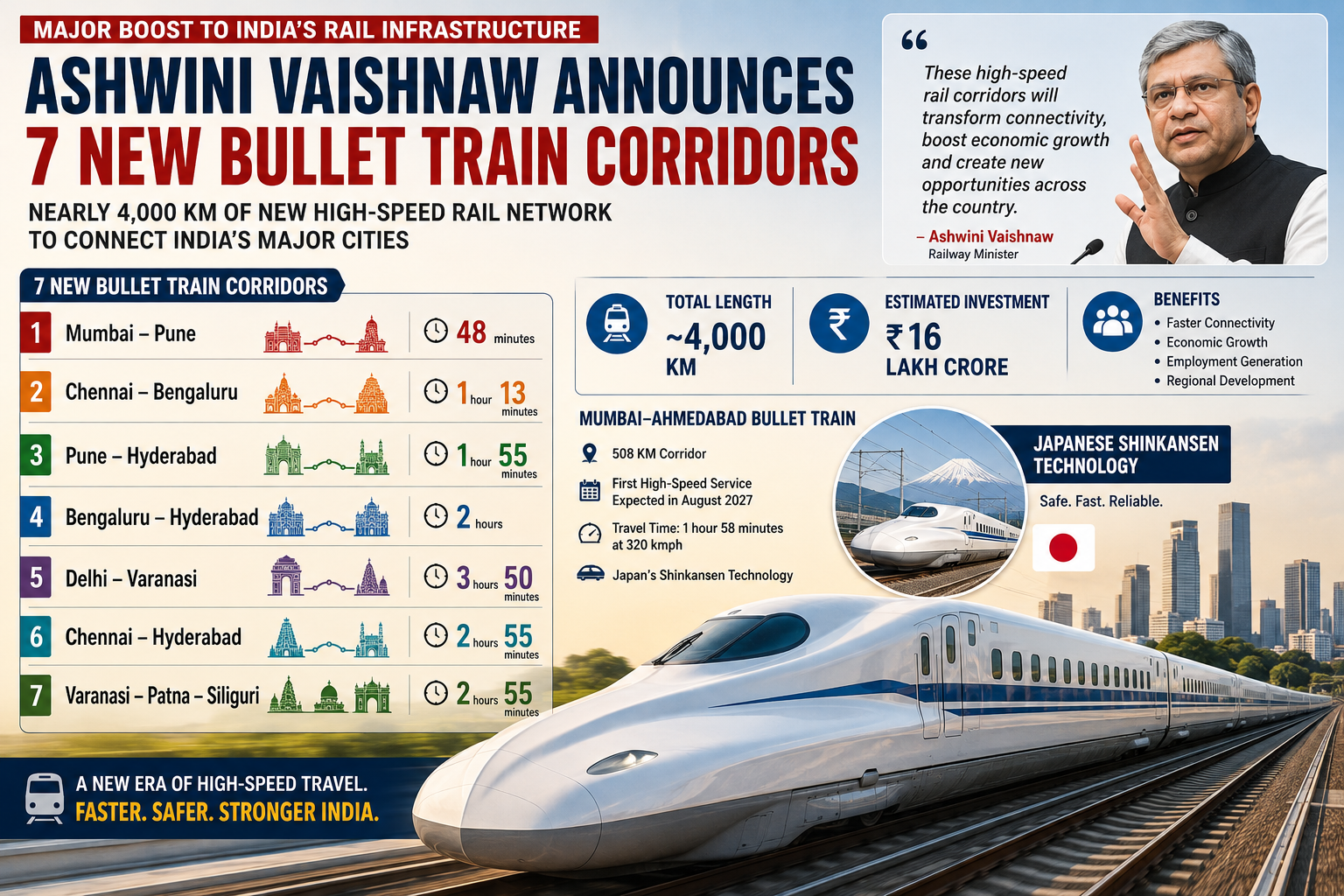
The proposed network will cover nearly 4,000 kilometres and is expected to attract investment of approximately ₹16 lakh crore. The corridors have been identified as major growth connectors aimed at improving inter-city mobility and strengthening economic links between regions.
Seven New Corridors and Their Travel Times
According to information released by the Ministry of Railways, the proposed corridors are expected to significantly reduce travel times between major cities:
High-Speed Rail Corridor Projected Travel Time
Mumbai–Pune 48 minutes
Chennai–Bengaluru 1 hour 13 minutes
Pune–Hyderabad 1 hour 55 minutes
Bengaluru–Hyderabad 2 hours
Delhi–Varanasi 3 hours 50 minutes
Chennai–Hyderabad 2 hours 55 minutes
Varanasi–Patna–Siliguri 2 hours 55 minutes
These figures represent projected travel times for the proposed high-speed services and are expected to make long-distance inter-city travel considerably faster once the corridors become operational.
Mumbai–Pune Journey Could Take Just 48 Minutes
The proposed Mumbai–Pune high-speed rail corridor is expected to have one of the most striking impacts on regional connectivity. The projected journey time is approximately 48 minutes, potentially allowing passengers to travel between the two major Maharashtra cities in less than an hour.
The corridor is expected to strengthen the economic relationship between Mumbai and Pune while supporting business, employment, education and tourism-related travel.
Chennai–Bengaluru in Just 73 Minutes
The proposed Chennai–Bengaluru corridor is expected to reduce the journey between the two major southern metropolitan centres to approximately 1 hour and 13 minutes.
The route forms an important part of the government's proposed high-speed rail network in southern India and is expected to improve connectivity between major technology, manufacturing and industrial centres.
Bengaluru–Hyderabad in Two Hours
Travel between Bengaluru and Hyderabad could take approximately two hours through the proposed high-speed rail connection.
The corridor would link two of India's major technology and business hubs, potentially creating faster movement of workers, entrepreneurs and business travellers between Karnataka and Telangana.
Pune–Hyderabad in Under Two Hours
The proposed Pune–Hyderabad corridor is expected to reduce travel time to approximately 1 hour and 55 minutes.
The connection would provide a high-speed link between major economic centres in Maharashtra and Telangana and could eventually become part of a larger southern and western high-speed rail network.
Delhi–Varanasi in 3 Hours 50 Minutes
The proposed Delhi–Varanasi high-speed rail corridor is expected to connect the national capital with one of India's most important cultural and religious centres in approximately 3 hours and 50 minutes.
The project is expected to strengthen connectivity across northern India and could provide a major boost to tourism, business and regional economic activity.
Chennai–Hyderabad in 2 Hours 55 Minutes
The proposed Chennai–Hyderabad corridor is expected to bring the journey time between the two major southern cities down to approximately 2 hours and 55 minutes.
Together with the Chennai–Bengaluru and Bengaluru–Hyderabad corridors, it is expected to form an important high-speed rail network connecting major southern economic centres.
Varanasi–Patna–Siliguri Corridor
Another major proposed route will connect Varanasi, Patna and Siliguri. The Ministry of Railways estimates that the journey between Varanasi and Siliguri could take approximately 2 hours and 55 minutes once the high-speed corridor becomes operational.
The corridor is expected to improve connectivity across Uttar Pradesh, Bihar and West Bengal while strengthening access to important economic, cultural and tourism centres in eastern India.
Nearly 4,000-Km High-Speed Rail Network
The seven proposed corridors together will cover nearly 4,000 kilometres, representing a major expansion of India's high-speed rail ambitions beyond the ongoing Mumbai–Ahmedabad project.
The government expects the proposed network to attract investments of around ₹16 lakh crore, highlighting the scale of the planned transformation in India's railway infrastructure.
Mumbai–Ahmedabad Bullet Train Sets the Foundation
India's first dedicated high-speed rail corridor, the 508-kilometre Mumbai–Ahmedabad High-Speed Rail project, is currently nearing completion. The corridor is being developed using Japanese Shinkansen technology and is expected to connect Mumbai and Ahmedabad in approximately 1 hour and 58 minutes. The first high-speed rail service is expected to begin in August 2027.
The experience gained from the Mumbai–Ahmedabad project is also being used to develop a standardised approach for future high-speed rail corridors. According to the Ministry of Railways, common engineering standards and designs for elements such as viaducts, tracks, stations, signalling and electrification could help reduce costs and accelerate construction.
A New Era for Inter-City Travel
The proposed corridors could fundamentally change long-distance passenger travel in India. Journeys that currently take several hours could eventually be completed in around one to four hours on some routes.
With the Mumbai–Pune journey projected at just 48 minutes, Chennai–Bengaluru at 1 hour 13 minutes, and Bengaluru–Hyderabad at 2 hours, the proposed network could create a new high-speed travel ecosystem linking India's major economic centres.
The seven corridors therefore represent more than an expansion of railway infrastructure. They are part of the government's broader vision of creating a national high-speed rail network that can support faster mobility, regional development, tourism and economic growth across India.