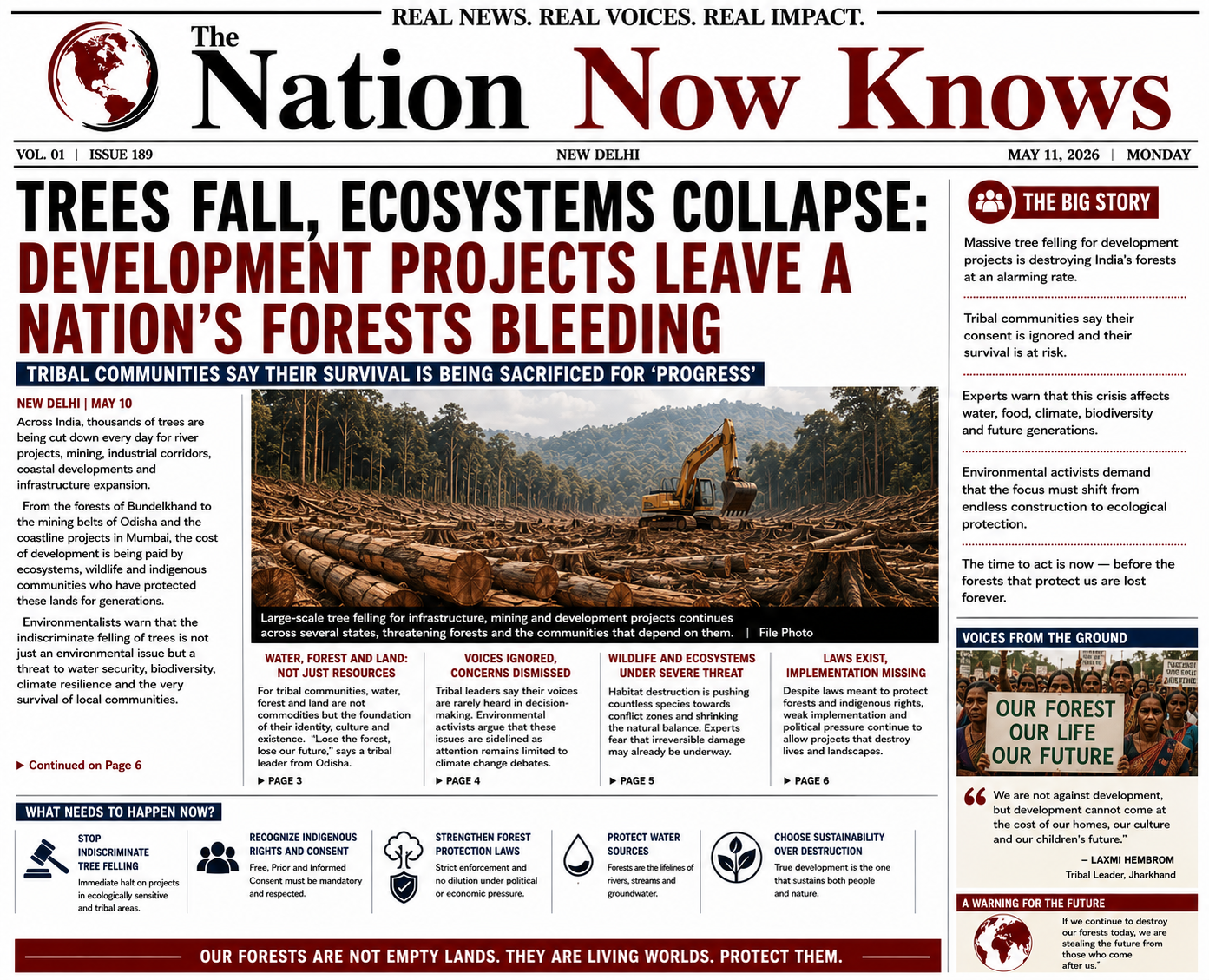
Across India, forests are disappearing in the name of progress. Mountains are being carved open, rivers redirected, coastlines reshaped, and ancient trees reduced to silence so highways, mines, ports, and industrial projects can rise faster than ever before. What is often presented as “development” on paper leaves behind scars that cannot be measured in economic reports alone.
A forest is not an empty piece of land waiting to be used. It is a living world.
Every tree cut down takes with it a network of birds, insects, animals, rivers, soil, and human lives that depended on it for survival. When forests fall, entire ecosystems collapse quietly. Streams dry up. Temperatures rise. Wildlife loses shelter. Villages lose balance. And people who have protected these lands for generations are pushed further into invisibility.
The deepest wound is carried by indigenous and tribal communities whose existence has always been tied to nature. For them, forests are not resources — they are memory, identity, ancestry, spirituality, and life itself. The land feeds them, heals them, and teaches them how to live in harmony with the earth. Yet their voices are often dismissed as obstacles standing in the way of “growth.”
This is the tragedy of our time: the people who protect nature the most are heard the least.
Modern society speaks endlessly about climate change, carbon emissions, and sustainability, yet often ignores the destruction happening directly on the ground. Climate conversations mean little if rivers are poisoned, forests erased, and native communities displaced in the process.
Environmental justice cannot exist without listening to those who have lived closest to nature for centuries.
The question is no longer whether development is necessary. It is whether development without conscience can truly be called progress.
A nation cannot become stronger by weakening its forests. It cannot claim prosperity while silencing the communities that stand as guardians of the land. True progress is not measured only by skyscrapers, highways, or industrial expansion. It is measured by whether rivers still flow clean, whether forests still breathe, and whether future generations inherit a planet that is alive.
The forest remembers everything humanity forgets.
And if we continue to destroy it in the pursuit of endless expansion, one day we may realize too late that we were not protecting nature — nature was protecting us all along.