Women Empowerment Through Food Processing and Value Addition: A Rural Enterprise Opportunity
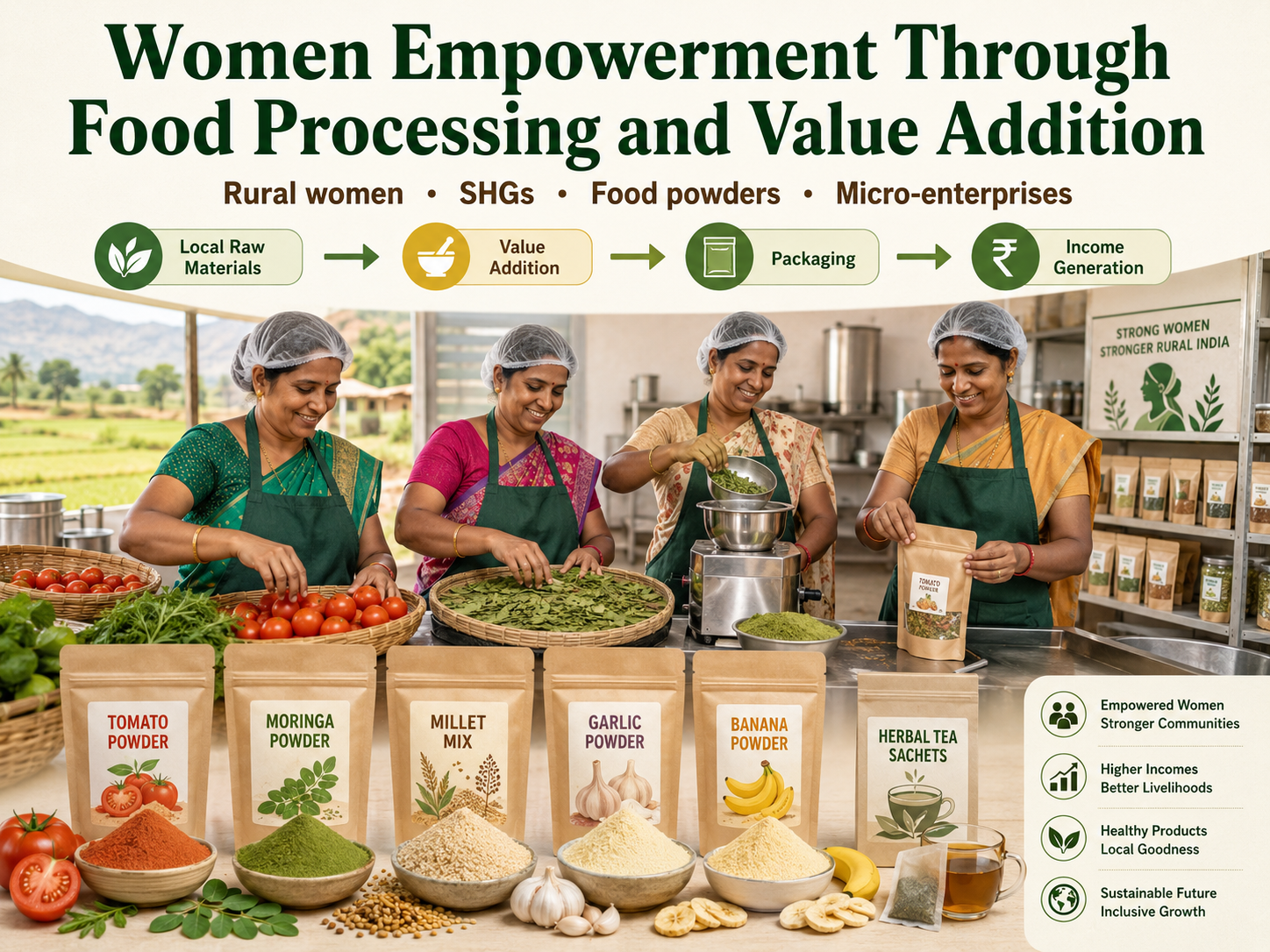
Women empowerment is an important pillar of rural development in India. Rural women possess traditional knowledge, food-handling skills and strong community participation. However, many still lack access to stable income opportunities, entrepreneurship training, branding support and market linkages.
Food processing and value addition can help address this gap. Instead of selling agricultural produce in raw form at lower prices, rural communities can convert vegetables, fruits, millets, herbs and spices into value-added products such as powders, health mixes, herbal teas, ready-to-cook mixes and nutrition blends.
This approach can create livelihood opportunities for rural women through Self-Help Groups (SHGs), Farmer Producer Organisations (FPOs) and small-scale enterprises.
India produces a wide range of agricultural commodities including tomato, onion, garlic, ginger, moringa, banana, mushroom, millets and traditional herbs. These products can be processed into higher-value items such as tomato powder, onion powder, millet-based nutrition mixes and herbal tea products.
The value of agricultural produce increases when it is properly cleaned, dried, processed, packed and marketed. This transformation can help rural women move towards enterprise-based income generation.
SHGs can play a key role in this process. Members can be trained in raw material handling, drying, grinding, packaging, labelling and local marketing. With basic machinery such as dehydrators, grinders and sealing machines, small production units can operate at the village level.
Food processing is suitable for rural women because it can begin on a small scale and gradually expand into a sustainable business activity. It can also help reduce food wastage by extending the shelf life of surplus fruits and vegetables through drying and processing.
Women-led food processing initiatives can positively impact household income, education, nutrition and social participation. Regular income opportunities may also improve financial stability and decision-making capacity within families.
Experts say the success of such initiatives depends on training, food safety awareness, packaging quality, branding and market access. Guidance related to hygiene standards, FSSAI registration and digital marketing is also important.
Common Facility Centres can support these activities by providing shared infrastructure for drying, grinding, packing and storage. Such centres can reduce investment costs and improve product quality for small groups.
Market linkage remains another important factor. Products developed by SHGs can be promoted through local retail stores, exhibitions, supermarkets and digital platforms.
There is also potential for institutional supply to schools, hostels, wellness centres and food businesses, provided quality standards and regular supply are maintained.
Government schemes, financial institutions, NGOs and private organisations can contribute through training, infrastructure support and marketing assistance under rural livelihood and women entrepreneurship programmes.
Food processing and value addition can become an important part of rural economic development by creating employment opportunities and encouraging women-led enterprises based on local resources.