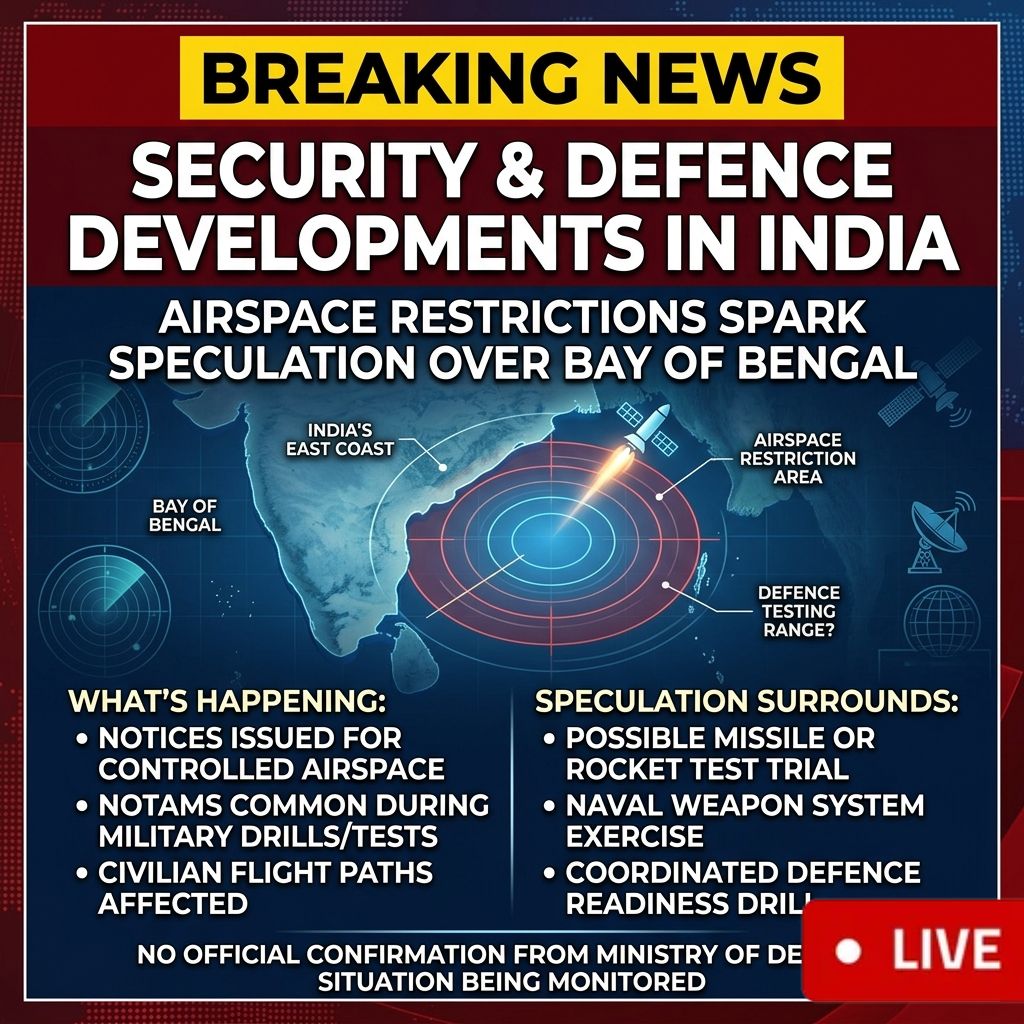
India has recently imposed temporary airspace restrictions over parts of the Bay of Bengal, drawing attention from observers and aviation watchers. Such restrictions are routinely issued for safety and operational purposes during certain strategic or technical activities.
What Is Known So Far?
Authorities have placed controlled restrictions over sections of the airspace above the Bay of Bengal. These notices are generally issued to ensure safety during activities such as:
- Military exercises
- Naval or aerial operations
- Space or technical launch activities
- Defence preparedness drills
As of now, no official statement has confirmed the exact purpose of the current restriction.
Routine Security and Operational Measure
Experts note that temporary airspace restrictions and NOTAMs (Notice to Airmen) are standard procedures followed by aviation and defence authorities to maintain operational safety and prevent civilian interference in restricted zones.
Observers have pointed out that maritime regions such as the Bay of Bengal are often used for strategic and technical activities because of their large open operational areas.
🇮🇳 Government Position
No formal announcement has been issued by the Ministry of Defence or related agencies regarding any specific operation linked to the restriction.
In matters related to defence and national security, official information is generally released only after activities are completed or formally confirmed.
Why Such Restrictions Matter
Temporary airspace restrictions help authorities:
- Ensure civilian aviation safety
- Secure operational zones
- Avoid interference during sensitive activities
- Maintain coordination between aviation and defence systems
Such measures are considered part of normal operational and strategic planning.
Conclusion
While the temporary airspace restriction over the Bay of Bengal has attracted public attention, there is currently no official confirmation regarding any specific defence or military activity connected to it. Until official information is released, the development should be viewed as a routine precautionary and operational measure.